
There is a good chance you found this article because of an email. Something like “SEO is dead, you need AEO now,” sitting in the inbox of a business owner who is already paying for SEO every month. The answer engine optimization vs SEO question lands differently when your money is on the table. Is this real? Is it a rebrand? Are you falling behind, or being sold a buzzword?
We run both disciplines, classic local SEO and AEO, on the same pages for the same real clients. So this is the plain-English comparison we give our own clients: the honest overlap, the five things that genuinely change, what stays exactly the same, and what is pure hype.
Answer Engine Optimization vs SEO: The Short Answer
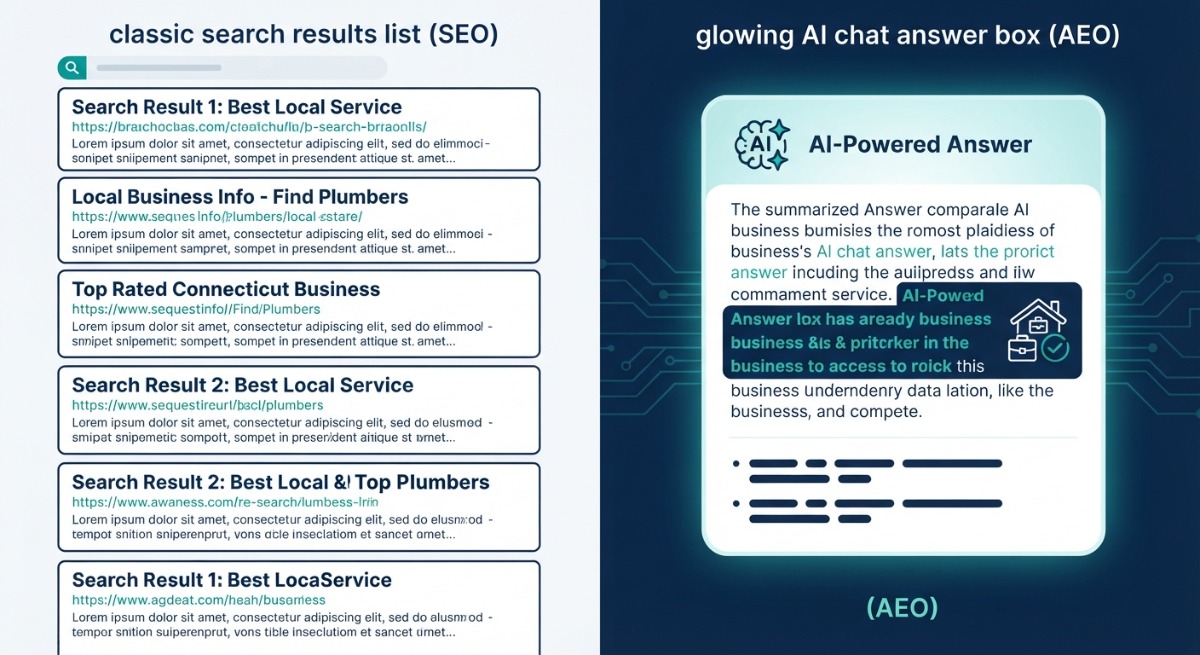
SEO gets your pages ranked in a list of results people click. Answer engine optimization (AEO) gets your business named inside the answer itself, whether that is a Google AI Overview or a ChatGPT response. The foundations overlap heavily. What changes is how you structure content, what you measure, and where answers appear.
That is the whole comparison in one breath. The rest of this article unpacks it, because inside that overlap sits a practical truth most pitches skip: for a local business, most of the work is shared, some of it is genuinely new, and some of what is being sold as AEO is rebranded SEO with a fresh invoice.
What Is AEO, and Why Is Everyone Suddenly Selling It?
A One-Paragraph Definition Without the Jargon
AEO means making your business the answer machines quote. When a homeowner asks Google or ChatGPT “who should I hire for house washing near me” or “how much does roof cleaning cost,” AEO is the work that makes your business the one named in the response, with your facts stated correctly.
You will also hear GEO, generative engine optimization. It is a near-synonym that comes from the research world and shows up in agency marketing. For a business owner the distinction changes nothing, so we are deliberately not going down that rabbit hole. Judge any proposal by its deliverables, not its acronym.
The Data Behind the Noise
The hype has a real engine underneath it. Here is what the actual research shows, with sources:
- When Google shows an AI summary, users click a traditional result only about 8% of the time, versus 15% without one, per Pew Research Center’s July 2025 study
- Click-through rates drop by roughly 20% when AI Overviews appear, in the Amsive study across roughly 700,000 keywords
- 77% of US ChatGPT users treat it like a search engine, per Adobe survey data
- 31% of US adults now interact with AI multiple times a day, per Pew Research Center’s March 2026 findings
- Only about 38% of AI Overview citations come from top 10 ranking pages, down from 76% a year earlier, in the Ahrefs 2026 study of 863,000 SERPs
That last number is the strategic headline. Ranking and being cited have decoupled. You can rank third and never be quoted, or rank fifteenth and be the answer. That decoupling is the real reason AEO exists as a discipline, and it is the one fact that makes “just ignore it” a hard position to defend.
AEO vs SEO: The Side-by-Side Comparison
The Comparison Table
Most AEO vs SEO tables are written for marketers. Here is ours, with the column that actually matters added on the right.
| Classic SEO | AEO | What it means for a local service business | |
| Goal | Rank pages in results | Be named in the answer | Be the company the machine recommends |
| Where you appear | The blue-link list and map pack | AI Overviews, ChatGPT, Perplexity, Gemini | New surfaces on top of the map pack, not instead of it |
| Query style | Keywords (“house washing Hartford”) | Full questions (“who should I hire to wash my house”) | Write pages around the questions customers actually ask |
| Content structure | Keyword-optimized pages | Question headings with direct answers | Put the answer in the first two sentences, then the detail |
| Key signals | Links, relevance, authority | Consistent entity data, reviews, third-party mentions | Your GBP, reviews and listings do double duty |
| Technical layer | Crawlability, speed, sitemaps | Same, plus schema that labels who you are | LocalBusiness and FAQ schema, no developer needed |
| Measurement | Rankings and clicks | Citations and mentions | Count calls, direction requests and “ChatGPT sent me” comments |
| Timeline | Weeks to months | Builds on the same foundation, less predictable | Fund the foundation, check AI visibility monthly |
Where They Overlap (Most of the Work)
Now the part the comparison tables undersell. Both disciplines stand on the same foundation: a crawlable, fast site, real expertise in the content, genuine reviews, consistent business data everywhere, pages people actually need, sensible internal linking, and the E-E-A-T qualities Google has preached for years.
Here is our blunt practitioner judgment, from running both on the same client pages: for a local service business, the majority of AEO is SEO done properly. That is an opinion built on experience, not a statistic, and we stand behind it. The genuinely new work is real, but it is the smaller share, and it sits on top of the old work, never beside it.
What Actually Changes: The 5 Real Shifts
So what is the new share? Five shifts, each one concrete enough to check your own website against.
Shift 1. From Ranking Pages to Answering Questions
The old standard was a page optimized around a keyword. The new standard is a page where every important question gets a heading and a direct answer of roughly 40 to 55 words right underneath, written so a machine can lift it whole.
The difference is visible in the first line. Old style: “Welcome to our website. We have proudly served the community for years with quality service and customer satisfaction.” Answer style: “House washing in Hartford County is a low-pressure soft wash that removes mold and algae from siding, and most single-family homes take a few hours.” One of these can be quoted. The other cannot.
Shift 2. From Keywords to Questions and Entities
Keyword lists become question lists, pulled from what customers actually type and ask. And the business itself becomes an entity: a single, consistent identity that machines can verify across your website, Google Business Profile, Bing, directories and review platforms.
Entity thinking for a pressure washing company looks like this: same exact business name everywhere, same phone number everywhere, services described in the same words on your site and your profiles, and reviews that mention those services by name. When every source agrees on who you are, machines can name you with confidence.
Shift 3. From One Search Engine to Many Answer Surfaces
SEO meant optimizing for Google. AEO means your answers can surface in Google AI Overviews, in ChatGPT, which leans on Bing’s index for live answers, in Perplexity, in Gemini, and through voice assistants.
The practical consequence for a local business is refreshingly specific. Bing stops being ignorable, because ChatGPT sees the web largely through it. And directories and third-party mentions matter again, because answer engines cross-check you against independent sources before naming you.
Shift 4. From Traffic Metrics to Visibility and Action Metrics
This is the uncomfortable shift. Your clicks can fall while your visibility rises, because people get the answer without visiting the page. So the scoreboard changes: AI citations and mentions, branded search growth, phone calls, form fills, direction requests.
An honest note on measurement: AI citation tracking is still young. For our own clients we run a monthly manual check, the same set of customer-style questions asked in ChatGPT and Google every month, logged in a simple sheet. Unglamorous, and currently more reliable than most dashboards selling themselves as the answer.
Shift 5. From Content Volume to Content Trustworthiness
The content-farm era rewarded volume. Answer engines compress the field: they quote a small number of sources per answer, so fewer, better, verifiable pages beat a large pile of thin ones.
Princeton researchers quantified part of this in the GEO study by Aggarwal et al.: adding quotable statistics, citations and expert quotations lifted AI visibility by up to 40% in testing. For a service business, that means real prices, real timelines and real review counts on your pages are now a visibility asset in both disciplines at once.
What Does NOT Change (And What Is Pure Hype)
Still True in Both Worlds
Real expertise still wins. Real reviews still win. A fast, clean, crawlable site still matters. Consistent name, address and phone still matters. Content that answers what people actually need still beats everything else. If your current local SEO is built on those things, none of that spend is wasted in the AI era. It is the raw material AI answers are made from.
The Hype Checklist: How to Spot a Repackaged SEO Pitch
We are an agency, and we will say it anyway: a lot of AEO pitches are smoke. Clients forward them to us, and the same red flags keep appearing:
- “SEO is dead” as the opening line
- Guaranteed ChatGPT rankings or guaranteed AI citations, which nobody can honestly promise
- A separate “AEO retainer” whose deliverables read exactly like your existing SEO retainer
- Heavy emphasis on llms.txt or one magic schema type as if it were the whole product
- No mention at all of your Google Business Profile, reviews or listings
Legitimate AEO work shows up in a proposal as restructured pages, question-driven content, entity cleanup across your listings, and new measurement habits. Ask to see those items named. If you have a pitch in hand and want a second opinion, we will read it with you, no charge, on a free growth call.
What This Looked Like on a Real Local Business Website
Theory needs a test site, and ours is Mr-Suds Power Washing PROs in Newington CT, the pressure washing client we also use as our own testing ground before we recommend anything to anyone else.
The site was built question-first from the start: 18 service pages structured around real customer questions with the direct answer at the top of each, 15 supporting articles, FAQ blocks with schema, and disciplined Google Business Profile and review management that reached a 5.0 rating across 39 reviews.
The result, in classic SEO terms: top 3 in the Newington map pack for 8 of 10 service keywords, and number 1 for house washing, soft washing and fence washing. The full build is described on our digital marketing for pressure washing companies in Connecticut page, and you can read what clients say on our real client reviews page.
Now the AEO reading of the same result, stated carefully. Nothing on that site had to be rebuilt for the AI era, because answer-ready structure was the build standard from day one. The same pages that won the map pack are the pages answer engines are built to quote. That is the overlap made visible: building for answers did not cost rankings. It is how the rankings were earned.
The Triage We Run on Existing Sites
Most businesses are not starting fresh, so here is the framework we use on existing content. Every page lands in one of three buckets.
Bucket one: pages that are fundamentally sound and only need an answer-first opener added under each heading. Bucket two: pages that need restructuring around questions, usually old brochure-style service pages. Bucket three: thin or overlapping pages that should be consolidated or retired, because they dilute the trust the good pages earn.
That triage answers the “does all my content need rewriting” fear: almost never. The step-by-step version of the work lives in our playbook, AEO for Local Service Businesses: How to Get Cited by ChatGPT & AI Overviews.
So What Should a Local Service Business Actually Do?
Four priorities, in order. Keep the SEO foundation funded, because it is also the AEO foundation, whether you run pressure washing crews, roofing crews or HVAC techs. Restructure content question-first as pages get touched, using the triage above rather than a panic rewrite. Fix entity consistency across your Google Business Profile, Bing and directories. Start a simple monthly AI visibility check so you are watching the new scoreboard.
For the complete step-by-step playbook, including the exact test prompts and the schema setup, go to our guide on AEO for local service businesses.
And one sentence for budget sanity: for most local businesses, this is an evolution of the existing SEO engagement, not a second bill.
FAQ: Answer Engine Optimization vs SEO
What is the difference between AEO and SEO?
SEO earns your pages a ranked position that people click. AEO earns your business a named place inside the answer itself, in Google AI Overviews or tools like ChatGPT. The foundations overlap heavily; the differences are content structure, the surfaces you optimize for, and what you measure.
Is AEO replacing SEO?
No. AEO sits on top of SEO and depends on it. Answer engines draw on the same crawlable pages, reviews and business data that search engines rank. What is being replaced is the assumption that ranking first automatically means being seen first.
Do I need AEO if I already do SEO?
If your SEO already produces question-driven, answer-first content with consistent business data, you are doing most of AEO without the label. What you likely need to add is answer-surface coverage like Bing, plus new measurement habits. An audit of a few key pages usually settles it.
What is the difference between AEO and GEO?
In practice, very little for a business owner. AEO usually refers to optimizing for answer engines broadly, while GEO (generative engine optimization) comes from research on AI-generated results. Agencies use them almost interchangeably. Judge any proposal by its deliverables, not by which acronym it uses.
Does SEO still work now that Google has AI Overviews?
Yes, but the payout changed. Pew Research found users click a traditional result only about 8% of the time when an AI summary appears, versus 15% without one. Rankings still drive the visibility AI answers are built from, so SEO remains the foundation.
Can the same page rank in Google and get cited by AI?
Yes, and that should be the goal. A page with a clear question heading, a direct 40 to 55 word answer, supporting depth and schema can win a featured snippet, an AI Overview citation and a ChatGPT mention from the same content.
What should a small business prioritize, SEO or AEO?
Prioritize the shared foundation: Google Business Profile, reviews, consistent listings and genuinely useful service pages. Then layer AEO habits on top: question-first structure, real numbers on pages, Bing coverage and a monthly AI visibility check. Treat it as one budget, not two.
Find Out Where You Stand in AI Search
You now know what changes, what does not, and how to spot the hype. The open question is where your own website sits: which pages are answer-ready, which are invisible to AI, and whether your current SEO is already quietly doing the AEO job.
That is what our free audit answers, including the answer-readiness check described in this article, page by page, in plain English.
Get Your Free Growth Audit
MR Web Solutions, Hartford CT. Call us at +1 860 255 1070.