
A few months back, one of our clients got a call that started with a sentence we now hear more and more: “I asked ChatGPT who does house washing near me, and it gave me your name.” That call is why AEO for local service businesses is suddenly on every owner’s mind. AI answers now sit on top of local searches, and the businesses they name get the phone calls.
The good news is that getting named is not luck. There is a repeatable playbook, and we have run it with a real Connecticut pressure washing company. In this guide we will walk you through the exact steps, plus a self-test you can run on your own business in the next 10 minutes.
What Is AEO for Local Service Businesses?
AEO (answer engine optimization) for local service businesses means structuring your website, Google Business Profile, reviews, and directory listings so AI tools like ChatGPT and Google AI Overviews can find, trust, and name your business when a homeowner asks who to hire.
That is the whole idea in one sentence. The reason it matters right now is simple. When a homeowner types a question, the AI answer often appears before any traditional listing. If that answer names your competitor, the click and the call go to them. AEO is how you become the business the machine mentions.
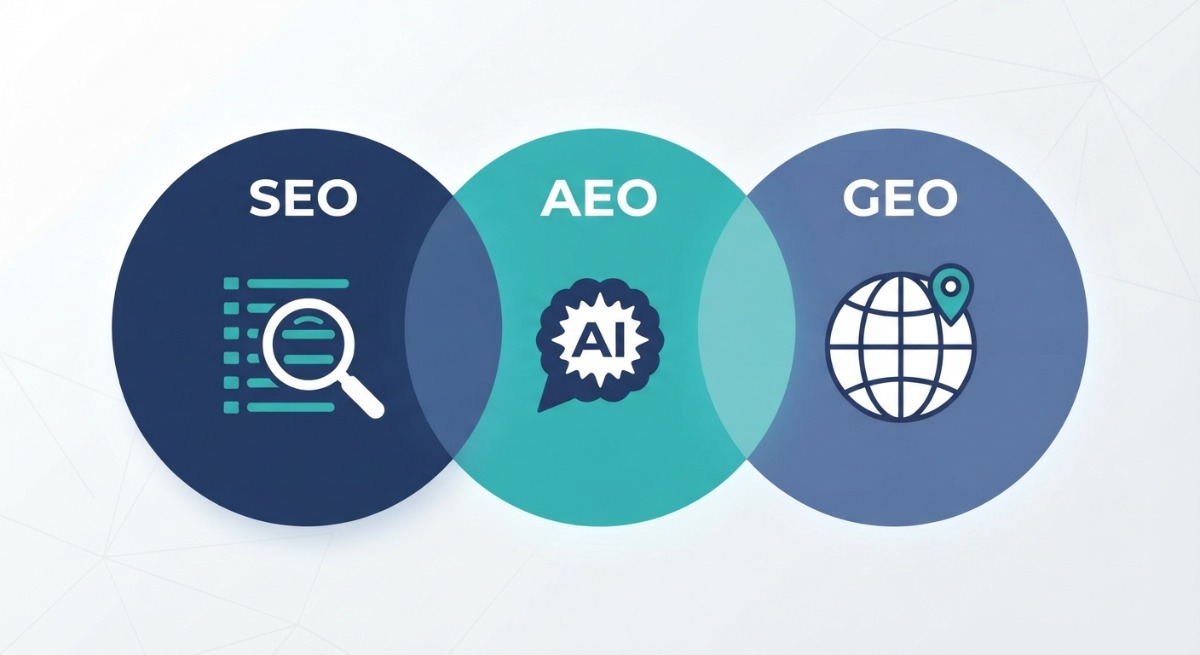
AEO, SEO and GEO in One Minute
SEO gets your pages ranked in the classic list of search results. AEO gets your business named inside AI-generated answers. GEO (generative engine optimization) is the broader research term for the same discipline, applied to every AI engine.
We break down the full differences in our guide Answer Engine Optimization vs SEO: What Actually Changes. This article stays focused on the doing.
The Good News: Your Local SEO Work Already Counts
If you have been doing local SEO properly, you are most of the way there. Your Google Business Profile, your reviews, your service pages, and your consistent name, address and phone are the exact foundation AI systems read when they build local answers.
AEO does not replace that work. It builds on it. The steps below are mostly about sharpening what you already have so a machine can quote it.
How Do ChatGPT and Google AI Overviews Actually Pick Local Businesses?
Before the playbook, you need to understand two things about how these systems choose. Once you see the logic, every step below will make sense.
ChatGPT Looks Through Bing’s Eyes
When ChatGPT answers a live local question, it does not crawl the web on its own. It leans on Bing’s search index and Bing’s local business data.
The consequence is blunt. A business that is invisible on Bing is largely invisible to ChatGPT for live local queries. And here is what we see in the field: most local service businesses have never claimed Bing Places and have never verified their site in Bing Webmaster Tools.
That is not a weakness. That is an opening. Two free setups that most of your competitors skipped put you in the pool ChatGPT actually draws from.
AI Overviews Pull From Pages Google Trusts, but Not Only Page One
Google AI Overviews cite specific pages as sources. The interesting part is where those pages rank.
Ahrefs studied 863,000 keyword SERPs containing 4 million cited URLs in 2026 and found that only about 38% of AI Overview citations came from top 10 results, down from 76% a year earlier. You can read the data in the Ahrefs study on search rankings and AI citations.
Translation for a busy owner: you no longer have to outrank the national directories to get cited. You have to be the clearest, best-structured answer to the question being asked.
One more detail from that same study worth knowing. YouTube was the single most cited domain. If you already film your jobs for social media, those videos are quietly working for you in AI search too.
The Signals Both Systems Reward
Across ChatGPT and AI Overviews, the same handful of signals keep deciding who gets named:
- A consistent business identity everywhere: same name, address and phone on every listing
- Reviews with substance, not just star counts
- Pages that answer questions directly in the first sentences
- Structured data that labels who you are and what you do
- Mentions on third-party sites: directories, local press, and community threads where locals ask for recommendations
Everything in the playbook below strengthens one or more of these.
The 7-Step Local AEO Playbook We Use With Clients
This is the sequence we run for our own clients. Do it in order. Steps 1 and 2 cost nothing but time.
Step 1. Run the 10-Minute AI Visibility Test
Open ChatGPT and ask it the questions your customers would ask. Swap in your trade and your town:
- “Who is the best pressure washing company in Newington CT?”
- “Who should I hire for roof cleaning in Hartford?”
- “Recommend a reliable house washing service near Newington Connecticut.”
Then go to Google and search question-style queries like “how much does house washing cost in Hartford CT” and see whether an AI Overview appears, which businesses it names, and which pages it cites.
Log three things in a simple note or spreadsheet: which businesses got named, whether you were one of them, and whether anything the AI said about your business was wrong. Wrong hours, an old address, a dead phone number.
This test is your baseline. You will rerun it monthly, and every step after this exists to change what it shows.
Step 2. Lock Down Your Business Identity Everywhere
AI systems cross-check you across the web. If your website says one phone number, an old directory says another, and your Facebook page shows a third, the machine has two versions of your business and no way to know which is real. Some systems hedge. Some skip you.
Work through this checklist:
- Search your business name plus every phone number you have ever used
- Fix mismatches on your website, Google Business Profile, Bing Places, Apple Business Connect, Yelp, Facebook, and any industry directories
- Kill or correct listings for old addresses and old business names
- Claim Bing Places and verify your site in Bing Webmaster Tools while you are at it, because this is the ChatGPT doorway from Step 1
This is called NAP consistency (name, address, phone), and it is the least glamorous, highest-leverage work in local AEO.
Step 3. Make Your Google Business Profile the Best Answer in Town
Your Google Business Profile is the single most-read local data source for AI local answers, and it feeds Gemini and AI Overviews directly.
When we take over a client profile, we fill it in this order: primary and secondary categories first, then every service listed with its own short description, then the full service area town by town, then the Q&A section seeded with real customer questions, then photos from actual jobs, then a steady rhythm of posts.
Most profiles we audit have a category, a phone number, and nothing else. A complete profile reads like an answer. An empty one reads like a rumor.
Step 4. Restructure Service Pages So a Machine Can Quote Them
This is the on-page heart of AEO. AI systems lift answers from pages that are built like answers. Most service pages are built like brochures.
The fix: question-first headings, a direct answer under each, real specifics, town names, and an FAQ block at the bottom of every service page.
The Answer-First Paragraph Formula
Use this pattern on every service page. A question as the heading. A direct answer of roughly 40 to 55 words immediately under it. Depth below that.
Here is a before and after from the kind of rewrite we do on pressure washing sites.
Before: “At our company, we pride ourselves on delivering exceptional exterior cleaning solutions tailored to your unique needs. Our experienced team uses state-of-the-art equipment to ensure your complete satisfaction.”
After, under the heading “Is soft washing safe for my siding?”: “Yes. Soft washing cleans siding with low pressure and a detergent mix instead of blasting it with high pressure, so it removes mold and algae without damaging vinyl, wood, or painted surfaces. It is the method we recommend for most Newington and Hartford homes.”
The first version says nothing a machine can quote. The second one is a complete answer with a method, a reason, and a location. That is what gets lifted.
Put Real Numbers on the Page
Princeton researchers tested what makes AI engines cite a source in their GEO study on generative engine optimization. Adding statistics, quotations and citations lifted AI visibility by roughly 20 to 40% in testing, and the statistics tactic reached about a 41% lift on some measures.
For a service business, your “statistics” are your prices or price ranges, your timelines, your years in business, your job counts, and your review numbers. Real ones only. A page with concrete numbers reads as evidence. A page without them reads as filler, to humans and machines alike.
Step 5. Turn Reviews Into Machine-Readable Proof
AI systems do not just count your stars. They summarize what your reviews actually say, and what you say back.
Two changes make your reviews work harder. First, ask for specifics. A review that says “great job on our house washing in Newington” feeds the machine a service and a town. A review that says “great job” feeds it nothing. When you ask a happy customer for a review, mention the service by name and the town, and most people will naturally include both.
Second, respond to every review, good and bad. Owner responses are part of the text AI systems read, and they signal an active, accountable business.
One hard line here. The FTC’s rule banning fake and incentivized reviews has been in force since October 2024. You can read it on the FTC’s fake review rule page. Never buy, trade, or fake reviews. Honest volume wins, and it wins for longer.
Step 6. Add the Two Schema Types That Matter for Local
Schema markup is code that labels your content for machines. For a local service business, only two types carry most of the weight: LocalBusiness schema, which tells machines who you are, where you work, and how to reach you, and FAQPage schema, which marks your question-and-answer blocks as exactly that.
Here is the part most articles hide from you: you do not need a developer. SEO plugins like Rank Math generate both schema types from a settings screen, no code involved. If your site runs WordPress, this is an afternoon of setup.
A quick note on llms.txt, since owners keep asking. It is a small file that offers AI crawlers a summary of your site. It is optional, low effort, and its benefit is unproven so far. Fine to add. Never a substitute for the steps above.
Step 7. Get Mentioned Where AI Reads
AI systems trust businesses that exist beyond their own website. Third-party mentions are the off-page half of AEO.
The surfaces worth your time: local directories, your chamber of commerce and trade association pages, local news when you have a story worth telling, supplier or franchise pages that list dealers, and community threads on Reddit and Facebook where locals ask for recommendations.
On community threads, one rule keeps you welcome: answer as a helpful local expert and say who you are. “I run a pressure washing company in town, here is what that stain probably is and how to treat it” builds trust and mentions. Dropping your link with no context gets you deleted and remembered for the wrong reason.
That is the full playbook. If this list feels like a second job, this is literally what we do all day. You can book a free growth call and hand it to us instead.
What This Looked Like for a Real Pressure Washing Company in Connecticut
Theory is cheap, so let us show you the playbook on a real business. Mr-Suds Power Washing PROs is our pressure washing client in Newington CT, and it is also the business we use as our own testing ground for everything we recommend in this article. When they started with us, they were competing against established names that had years of head start.
Here is what we built, in the same order we gave you above. Eighteen service pages structured question-first, covering every service and the towns around Newington and Hartford. Fifteen supporting articles answering the real questions homeowners ask. Disciplined Google Business Profile management, filled in the exact order from Step 3. A review engine built on asking specific, honest requests, which reached a 5.0 rating across 39 reviews. Consistent listings across every platform that matters.
- What happened in traditional local results: top 3 positions in the Newington map pack for 8 of 10 service keywords, and the number 1 spot for house washing, soft washing, and fence washing. You can see this work in context on our digital marketing for pressure washing companies in Connecticut page, and what clients say about working with us on our real client reviews page.
Now the AI connection, framed honestly. These assets, the profile, the reviews, the answer-first pages, the consistent listings, are exactly what AI systems read when they assemble a local answer. AI citation is the newest layer on top of these fundamentals, and we run the same monthly visibility test on Mr-Suds that we taught you in Step 1. The businesses with this foundation in place are the ones AI names, because they are the ones the machines can actually verify.
The Part Most Owners Skip
None of those results came from a trick. The work that moved the needle was the unglamorous kind: cleaning up old listings, answering every review, rewriting brochure pages into answer pages.
There is no hack in this article because there is no hack in this discipline. Consistency over months beats cleverness over a weekend, every time.
How Do You Know It Is Working? A Simple Monthly AI Visibility Check
Set a 30-minute appointment with yourself each month and run this routine.
Rerun the Step 1 prompts in ChatGPT, the same queries every time, and log which businesses get named. Check the AI Overviews for your question-style Google searches and note the cited pages. Open Bing Webmaster Tools and look at your performance data. Glance at your Google Business Profile stats for calls and direction requests. Watch whether searches for your business name are trending up, because branded search grows when people hear about you elsewhere, including from AI.
Keep it all in one simple spreadsheet with a row per month. Direction matters more than any single month’s numbers.
Now the honest expectations. Foundation signals, the listings, profile and page work, start influencing local visibility within weeks to a few months. AI citations build on that same foundation and are less predictable, because this field is young and the systems change often.
Which leads to one sentence we want you to remember: anyone promising you guaranteed ChatGPT rankings by a set date is selling smoke. No honest agency makes that promise, including us. What can be promised is the foundation, and the foundation is what gets cited.
Mistakes That Keep Local Businesses Out of AI Answers
We see the same handful of mistakes in almost every audit:
- Publishing AI-written filler with no local facts, no prices, and no specifics a machine could quote
- Ignoring Bing entirely, which means ignoring ChatGPT
- Running three versions of your name, address and phone across old listings
- Begging for reviews or incentivizing them, which violates the FTC rule and risks worse than a penalty: your credibility
- Blocking AI crawlers in robots.txt without realizing it, often from a copy-pasted config
- Stuffing “best in town” claims everywhere with no numbers, reviews, or proof behind them
Every one of these is fixable in days, not months. Most of your competitors will fix none of them.
FAQ: AEO for Local Service Businesses
How do I get my business recommended by ChatGPT?
Make sure Bing can see you: claim Bing Places, verify your site in Bing Webmaster Tools, keep your name, address and phone consistent everywhere, and publish pages that answer real customer questions directly. ChatGPT’s live local answers lean heavily on Bing’s index and on well-reviewed, clearly described businesses.
How long does AEO take to work for a local business?
The foundation work, meaning listings, Google Business Profile, and answer-first pages, starts influencing local visibility within weeks to a few months. AI citations build on that same foundation and are less predictable. Be suspicious of anyone promising a guaranteed ChatGPT mention by a set date.
Does AEO replace local SEO?
No. AEO sits on top of local SEO. The same signals that win the map pack, meaning reviews, consistent listings, and strong service pages, are what AI systems read. If you stop doing local SEO, your AEO collapses with it.
Do I need schema markup to show up in AI answers?
Schema is not an absolute requirement, but LocalBusiness and FAQPage schema make it easier for machines to identify who you are, where you work, and what you answer. SEO plugins like Rank Math generate both without code, so there is no reason to skip it.
How do I check if AI Overviews mention my business?
Search Google for question-style queries your customers ask, like “how much does house washing cost in Hartford CT,” and read the AI Overview and its cited links. Repeat monthly with the same list of queries and log which businesses and pages appear.
What if ChatGPT says something wrong about my business?
Fix the source data. Wrong hours, old addresses or dead phone numbers usually trace back to inconsistent listings. Correct your Google Business Profile, Bing Places and major directories, then recheck in a few weeks. AI systems refresh from the same public sources.
Can I do AEO myself or should I hire someone?
An owner can absolutely do the core steps: consistent listings, a strong Google Business Profile, honest reviews and answer-first service pages. It costs time more than money. If you would rather spend those hours on jobs, that is exactly what an agency audit is for.
Get Your Free AI Visibility and Growth Audit
You have the playbook. If you would rather not run it alone, we will run the full visibility check from this article on your business and show you exactly where you stand: what AI systems currently say about you, where your listings disagree with each other, and which pages are ready to be cited.
No pressure, no jargon, just a clear picture and a prioritized fix list.
Get Your Free Growth Audit
MR Web Solutions, Hartford CT. Call us at +1 860 255 1070.