
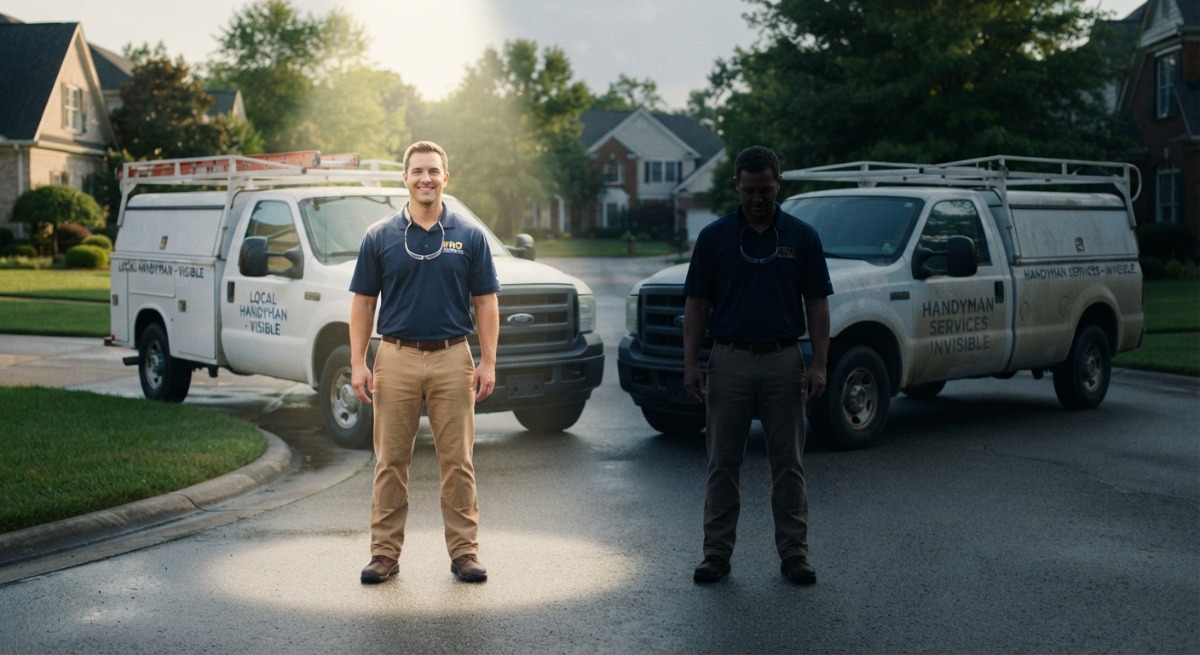
Picture two contractors in the same town. Similar reviews, similar websites, similar trucks. One shows up everywhere on Google, sits in the map pack, and even gets named when someone asks an AI tool for a recommendation. The other is invisible. The difference is usually not keywords, and this is exactly what entity SEO for contractors explains: whether Google actually understands who your business is, what it does and where it works.
We do this work for local trade businesses, and in this guide we will explain it the way we explain it to our own clients: in plain English, with the exact entity checklist we ran on a real Connecticut pressure washing company, and with honest notes on what it cannot do.
What Is Entity SEO for Contractors?
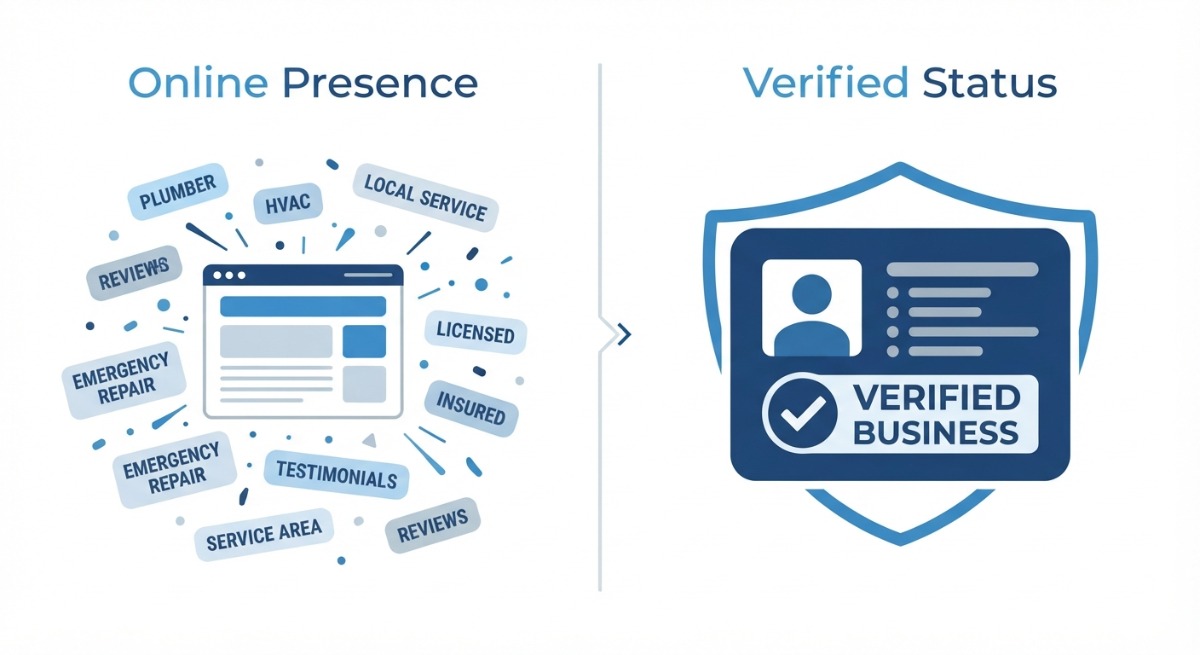
Entity SEO for contractors is the practice of making Google recognize your company as one clear, trusted business, an entity, with a defined name, defined services and a defined service area, so it can confidently show you in the map pack, organic results and AI answers. Google builds that understanding from your Google Business Profile, website, schema markup, reviews and citations.
In other words: keywords tell Google what a page is about. Entity signals tell Google who you are. Both matter, but the second one now decides whether you are even in the running.
Entity SEO vs Keyword SEO: What Changed?
| Keyword SEO | Entity SEO | |
| Targets | Search queries | Google’s understanding of your business |
| Unit of work | Pages and phrases | One consistent business identity |
| Wins | A ranking for a phrase | Eligibility across map pack, organic and AI answers |
| Breaks when | The query changes | Your data contradicts itself across the web |
This is not a new invention. Google has been entity-driven since the Knowledge Graph, its database of known things and businesses, launched in 2012. What changed is urgency: AI search made entity understanding the ticket to the game.
Why This Matters More in the AI Search Era
Two numbers frame it. In BrightLocal’s Local Consumer Review Survey 2026, 45 percent of consumers said they now use ChatGPT or other generative AI tools for local business recommendations. And SOCi’s 2026 Local Visibility Index found that visibility in ChatGPT recommendations is far harder to earn than a Google local ranking.
AI systems recommend entities they can verify, not pages that repeat keywords. Every signal in this article is a signal those tools cross-check before they say your name. We covered the AI answer side in depth in our guide to AEO for local service businesses; this article covers the identity layer underneath it.
How Does Google Decide What Your Contracting Business Is?
Here is the mental model, built on Google API analysis published by Search Engine Land in January 2026 and matching what we see in client audits. Google works in two layers. First it classifies what you are, mainly from your business name’s meaning plus your primary Google Business Profile category. Only then does it decide how relevant you are for any given search.
Eligibility comes before ranking. If Google has classified you as the wrong kind of business, no amount of optimization on top will fix the results, because you are competing in the wrong race.
Your Business Name Sends Signals Whether You Like It or Not
A name like “Mr-Suds Power Washing PROs” tells Google the trade inside the name itself. A name like “RJ Enterprises” tells Google nothing, so every other signal has to work harder.
To be clear: never stuff keywords into your Google Business Profile name to compensate. That violates Google’s guidelines and risks suspension. A vague name is not a death sentence; it just means your category, schema and content need to carry more of the load.
Your Primary Category Is the Strongest Single Signal
Your primary GBP category is a claim about what your business is, and it outweighs every secondary category. Choose the one that matches the service that makes you the most money, not the broadest one.
When we audit contractor profiles, the wrong primary category is the single most common finding. And when your exact trade has no category, pick the closest parent category, then reinforce the specifics through your listed services, your pages and your reviews. Your primary category is a claim; everything else is evidence.
Everything Else Corroborates or Contradicts
Your website, schema, citations (mentions of your business details on other sites), reviews, directories and social profiles all either agree with that claim or quietly undermine it. Consistency is the mechanism: same name, same address, same phone, same service list, everywhere Google looks. One old listing with a dead phone number is a contradiction in the file Google keeps on you.
How to Check What Google Currently Thinks You Are (5-Minute Audit)
Do this while you read. Five minutes, no tools, and you will know whether you have an entity problem.
Search Your Exact Business Name
A healthy brand SERP, the results page for your own name, looks like this: your Business Profile panel on the right, your website first, and your consistent profiles listed below. A confused one shows no panel, a different business with a similar name, or a directory outranking your own site. Confusion here means confusion everywhere.
Check Your Knowledge Panel and About This Result
If a panel appears, read it like a stranger would. Right categories? Right towns? Right hours? Then click the three dots next to your website result and read About this result, which shows how Google describes your site in its own words.
Ask the AI Tools Directly
Ask ChatGPT, Gemini and Google’s AI Mode two questions, phrased like a real customer: “Who is [your business name] in [your town]?” and “Who is the best [your trade] in [your town]?” Note what they say about you and what they get wrong. The errors are your to-do list, because AI tools repeat whatever the public record tells them.
Audit Your GBP Categories Against What You Actually Sell
Make a four-column table and fill it honestly:
| Service you sell | Keyword customers use | GBP category or service covering it | Covered? |
| House washing | house washing near me | Pressure washing service + listed service | Yes |
| Roof cleaning | roof moss removal | Not listed anywhere | No |
Every “No” row is a service Google does not know you offer, which answers the painful question of why a competitor shows up for work you also do.
The Contractor Entity Checklist: 9 Signals That Make Google Understand You
This is the working checklist we run at MR Web Solutions, scoped to what an owner can actually do. Each signal ends with what to do this week.
1. One Consistent Name, Address and Phone Everywhere
NAP consistency, meaning your name, address and phone number matching exactly across the web, is the foundation signal. This week: search your business name plus every phone number you have ever used, and fix or kill every listing that disagrees with your current details.
2. A Fully Built Google Business Profile
Categories, every service listed with a description, service area towns, attributes, real job photos, and regular posts. Google’s own research, reported via BrightLocal, found consumers are 2.7 times more likely to consider a business reputable with a complete profile. This week: fill every empty field, starting with services.
3. LocalBusiness Schema With sameAs and area Served
Schema markup is code that labels your business facts for machines. Here is a realistic contractor example (the lines starting with // are plain-English notes; remove them before pasting):
{
“@context”: “https://schema.org”,
“@type”: “LocalBusiness”,
// Use your exact business name, matching your GBP
“name”: “Apex Roof Cleaning LLC”,
“telephone”: “+1-860-555-0100”,
“url”: “https://www.apexroofcleaning.com”,
// Your real registered address, matching every listing
“address”: {
“@type”: “PostalAddress”,
“streetAddress”: “12 Main St”,
“addressLocality”: “Newington”,
“addressRegion”: “CT”,
“postalCode”: “06111”
},
// The towns you actually serve
“areaServed”: [“Newington CT”, “Hartford CT”, “Wethersfield CT”],
// Links that prove this is the same business everywhere
“sameAs”: [
“https://maps.google.com/your-business-profile-link”,
“https://www.facebook.com/yourpage”,
“https://www.yelp.com/biz/yourlisting”
]
}
This week: if your site runs WordPress, an SEO plugin like Rank Math can generate LocalBusiness schema from a settings screen, no developer needed.
4. One Clear Page Per Service
Each service page should define one service entity: what it is, where you do it, what it roughly costs, and how the process works. One page trying to cover eight services defines nothing. Mr-Suds runs 18 live service pages for exactly this reason. This week: list your services and count your pages; the gap is your build list, and clean website architecture makes the build stick.
5. An About Page That Reads Like an Identity Record
Make your about page an identity record: founder name, founding story, license and insurance details, towns served, team photos. This is the page Google and AI systems cross-check when they ask “who is actually behind this business?” This week: add your license number and the year you started.
6. Reviews That Mention Services and Towns
BrightLocal’s 2026 survey found 97 percent of consumers read reviews for local businesses. But for entity purposes, review text matters as much as stars: reviews are corroboration, not just stars. When a homeowner in Newington writes “they soft washed our siding,” that one sentence teaches Google a service and a place at once. This week: when you ask happy customers for a review, mention the service and town naturally in your ask. Never script or fake review text.
7. Citations and Directories That Agree With You
The core set for contractors: Google Business Profile, Bing Places, Apple Maps, Yelp, Angi, HomeAdvisor, Thumbtack, Nextdoor, BBB, your chamber of commerce and your trade associations. Every one repeating the same facts strengthens the entity; every one contradicting them weakens it. This week: claim the top five and correct their details.
8. Topical Content That Proves You Do the Work
Articles and project posts around your actual services build topical authority, meaning Google sees depth in your trade, not generic filler. Mr-Suds supports its service pages with 15 published articles in its trade. This week: write up one recent job as a short project post with photos.
9. Real-World Proof: Photos, Projects, Licensing, Community Mentions
Job photos with real locations, project galleries, licensing bodies that list you, sponsorships and local press. These are signals no competitor can copy, because they come from work actually done. This week: upload ten real job photos to your profile.
Want us to run this checklist for you? That is exactly what our free growth audit does.
What We Saw With Our Own Client: Making Google Understand Mr-Suds
Theory is easy. Here is the checklist applied to one real business, told in order.
The Starting Point in Newington, Connecticut
Mr-Suds Power Washing PROs is a pressure washing company in Newington CT, a competitive suburb in the Hartford ring. It is our client and our own testing ground, the account where we run every entity signal ourselves before recommending anything to other trades. Like most local businesses, the brand existed in the real world long before Google understood it.
What We Actually Did
In sequence: locked the name and NAP everywhere. Built the Google Business Profile out completely, categories to photos. Created one page for each service, 18 live service pages across the generic, Newington and Hartford versions. Added LocalBusiness schema. Published 15 supporting articles in the trade. Installed a steady, honest review habit. The full program sits inside our digital marketing for pressure washing companies in Connecticut system.
What Happened
In the Newington map pack: top 3 positions for 8 of 10 service keywords, and number 1 for house washing, soft washing and fence washing. On the profile: a 5.0 rating across 39 reviews. We want to be honest about the shape of this result: it took months of consistency, not a trick, and the signals reinforced each other slowly and then all at once.
The Hartford Lesson: Entity Strength Does Not Teleport
Here is the part that surprised us, and the part no article in this space tells you. Hartford is the expansion market, one town over. Despite the strong Newington entity, Hartford started at zero map pack presence.
Google understands entities in a place. Being deeply verified in Newington did not transfer to Hartford; the location-specific proof, pages, reviews and local signals had to start being built again. If you plan to expand your service area, plan for that. Google does not rank businesses it does not understand, and it does not rank understanding it cannot verify locally.
How Long Does Entity SEO Take for a Contractor?
Honest ranges, no guarantees. Cleanup and setup fit in the first 30 days. Google typically re-reads categories and corrected listings within weeks. Meaningful movement in your brand SERP and the map pack usually shows within 3 to 6 months for an established business with reviews coming in.
New businesses in competitive metros should expect longer, because Google has less history to verify. Early movement looks like your name search cleaning up and your profile appearing for more of your services, before head keyword rankings move. Watch for that order.
Can You Do This Yourself or Do You Need Help?
A solo owner can absolutely handle the core: NAP cleanup, the GBP buildout and the review habit take a few hours a month, and this article is the checklist. Where owners usually want help is schema, service page architecture and steady content, because an owner who spent the day on a roof does not want to learn JSON-LD at 9pm.
For what it is worth, this entity work is built into our growth systems for trade businesses, starting from 90 dollars per month, alongside the broader local SEO work it feeds. That is the one sentence of pitch in this article.
FAQ: Entity SEO for Contractors
What is entity SEO in simple terms?
Making Google recognize your company as one clear, trusted business with a known name, known services and a known service area, so it can confidently show you for relevant searches. Keywords tell Google what a page is about; entity signals tell Google who you are.
Do contractors need a Wikipedia page or knowledge panel?
No. A knowledge panel helps larger brands, but for a local contractor the realistic entity backbone is a complete Google Business Profile, consistent citations, LocalBusiness schema and reviews. None of the results we reference in this article required a Wikipedia page.
Is entity SEO different from local SEO?
Local SEO is the outcome you want: map pack and local rankings. Entity SEO is the foundation underneath it. When Google clearly understands who you are, every local SEO effort sticks better, and the same signals now feed AI search tools.
How do I know if Google understands my business correctly?
Search your exact business name. A healthy result shows your Business Profile panel, your website first and consistent listings below. Then ask ChatGPT or Google’s AI Mode about your business and note the errors. Errors are your to-do list.
Does entity SEO help me show up in ChatGPT and AI Overviews?
It is the best available lever. AI systems recommend businesses they can verify across consistent sources. BrightLocal’s 2026 survey found 45 percent of consumers already use AI tools for local recommendations, so those verification signals now have direct commercial value.
What schema markup should a contractor use?
LocalBusiness schema, or a more specific subtype where one exists, with your name, address, phone, url, areaServed towns and sameAs links to your Google Business Profile and directory listings. Add Service schema on individual service pages where practical.
How long does it take for Google to recognize a business entity?
Cleanup reads within weeks. Meaningful movement in brand search and the map pack typically shows within 3 to 6 months of consistent signals for an established business. New businesses in competitive metros should expect longer.
Why does my competitor show up for services I also offer?
Usually because Google understands their identity better: a clearer primary category, services listed on the profile, a dedicated page per service and reviews mentioning that service. Run the audit in this article against their profile and yours side by side.
Find Out What Google Thinks Your Business Is
We will run the same entity audit we ran for Mr-Suds on your business: your brand SERP, your categories, your listings, your schema and what the AI tools currently say about you, then show you exactly where Google is confused and what to fix first.
Get Your Free Growth Audit
MR Web Solutions, Hartford CT. Call us at +1 860 255 1070.