
The truck is lettered, the work is good, and the phone either rings from Google or it does not ring at all. That is the blunt reality pressure washing SEO exists to change. Around 46 percent of Google searches carry local intent, and a homeowner who needs the house washed picks from the map and the first results they see, usually within a day.
This guide is the complete system we used to put a real Connecticut pressure washing company into the Newington map pack top 3 for 8 of 10 of its service keywords. It is written so you can run it yourself, step by step, or judge anyone you hire to run it for you. Both readers get the whole playbook, because hiding steps is how this industry earned your skepticism.
What Is Pressure Washing SEO?
Pressure washing SEO is the process of optimizing your website and Google Business Profile so your company appears in local search results and the map pack when people in your service area search for services like house washing, driveway cleaning or soft washing. It combines service pages, location pages, reviews, content and technical setup.
Just as important is what it is not. It is not ads, so you do not pay per click. It is not instant, so anyone promising rankings in two weeks is selling something else. And it is not a directory listing, so buying a profile on some marketplace does not do it for you.
The 10 steps at a glance:
- Research the keywords your customers actually type
- Plan the site architecture before writing pages
- Build one service page per service
- Add legitimate location pages
- Rebuild your Google Business Profile properly
- Run a real review system
- Publish content that supports your service pages
- Run an internal linking pass
- Clear the technical blockers
- Make it all quotable by AI search
The rest of this guide walks each step in order, with what we did on a real build threaded throughout.
Why SEO Beats Renting Leads for a Pressure Washing Company
Owned Rankings vs Paid Leads
Lead sellers resell the same homeowner to 3 to 5 companies, so you pay to race your competitors to a shared phone number. A ranking rings only your phone. That single difference changes the economics of everything downstream, because a ranked page keeps producing after the work that built it is paid for.
The Seasonal Math
SEO compounds into spring. Work done in the winter, when the trailer is parked, is exactly what puts you at the top when the April search surge hits, while ad campaigns reset to zero every time you pause them. For a seasonal trade, that timing is not a detail; it is the whole argument.
What the Map Pack Is Worth
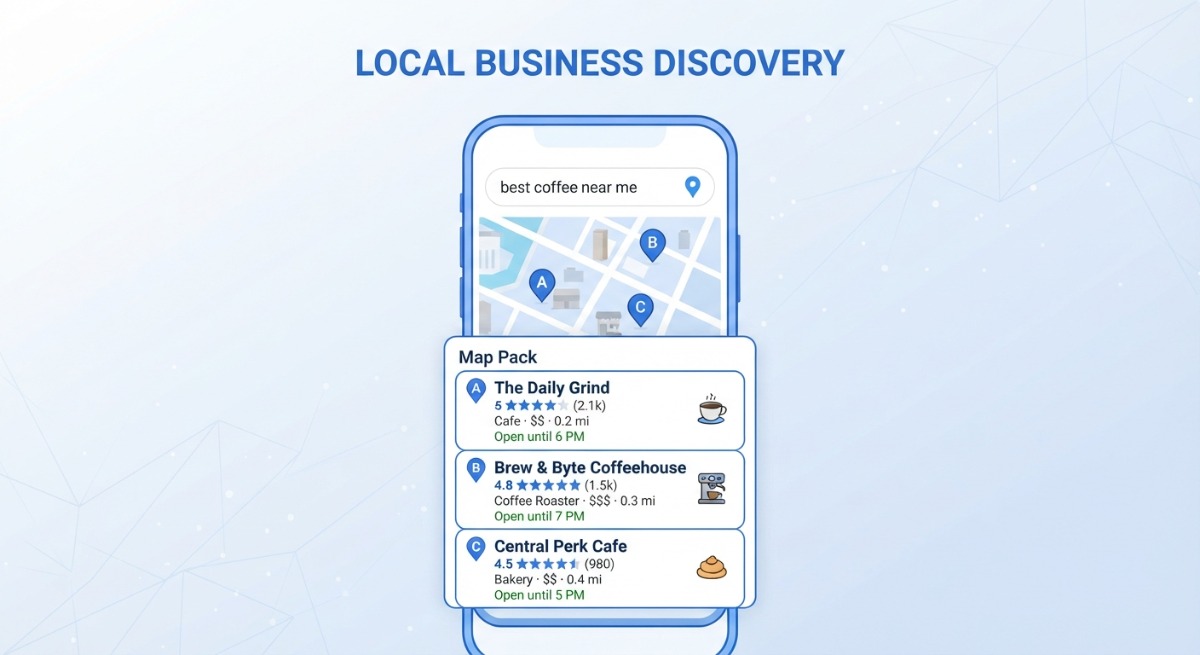
Commonly reported industry data puts the local pack at roughly 40 to 45 percent of clicks on local-intent results, and most “near me” mobile searches lead to a visit or call within a day. The map pack is the single most valuable rectangle on the page for this trade, which is why it gets its own dedicated playbook in our guide to the Google Map Pack for pressure washing, and why half the steps below feed it.
Step 1: Keyword Research: What Your Customers Actually Type
The Three Keyword Layers
Every keyword worth targeting in this trade falls into one of three layers. Service terms: pressure washing, house washing, soft washing, roof cleaning, gutter cleaning, driveway cleaning, deck cleaning, fence washing. Service plus city terms: house washing Newington CT, roof cleaning Hartford. Problem terms: green stuff on siding, black streaks on roof, slippery deck.
The first layer names your pages, the second layer localizes them, and the third layer feeds your articles. Keep the layers separate in your list, because they become different page types later.
How to Build the List Free
No paid tools required. Open your Google Business Profile insights and note the searches that already show your profile. Type each service into Google and harvest the Autocomplete suggestions and the People Also Ask questions. Read your three strongest competitors’ service menus for services you forgot you offer. Then run the list through Keyword Planner for rough volume ranges.
An hour of this produces a better keyword list than most paid audits, because it is built from your market instead of a national database.
Search Volume Reality in Small Towns
Here is the counterintuitive lesson that saves owners from quitting early: zero-volume keywords still bring jobs. Keyword Planner shows 0 for many town-level terms because its ranges round tiny volumes down, not because nobody searches them. We saw this directly in the Mr-Suds build, where Newington-level service terms that tools scored at zero produced the exact map pack visibility that drives calls.
If a term describes a real service in a real town you serve, build for it. The tool’s zero is a rounding artifact; the homeowner typing it is not.
Commercial vs Residential Keyword Intent
One more split worth making early: “pressure washing near me” is usually a homeowner, while “commercial pressure washing contracts” is a property manager or a competitor. The two audiences need different pages and different funnels, and the buyer side of that world is covered in our guide to commercial and HOA pressure washing contracts in Connecticut.
Step 2: Site Architecture: Build Silos Before You Build Pages
The Hub Structure
Before writing anything, sketch the site: homepage, service pages, location pages, blog, proof pages (reviews, projects), contact. Every page you ever publish should have an obvious home in that sketch. Sites fail not from missing pages but from pages nobody planned, piled where nothing connects.
What We Mean by a Silo
A silo is services grouped and interlinked by topic, so Google understands what you do and where you do it. The house washing page links to the soft washing page, both link to the Newington location page, and everything links up to the homepage and down to supporting articles. The structure itself is a ranking signal, because it turns forty loose pages into one legible business.
The Mr-Suds Three-Layer Model
Here is the architecture we ran on a real site. One generic service page per service. A Newington version of the key services. A Hartford version for the expansion market. Eighteen live service pages total, each with one job.
When should you copy this? When you genuinely compete in multiple towns. A single-town company needs one layer, done deeply. A company with a home market plus an expansion market, which is most growing operations, needs exactly this structure, and almost none of them have it.
Keeping City Versions From Cannibalizing Each Other
Three pages about house washing can compete with each other if you are careless. The fix is discipline: one keyword target per page, distinct titles (house washing vs house washing in Newington CT vs house washing in Hartford), unique local proof on each city version (that town’s jobs, that town’s reviews), and different internal link paths, so the Newington page is linked from Newington content and the Hartford page from Hartford content. Google separates pages that you have clearly separated.
Step 3: Service Pages That Rank and Convert
The Anatomy of a Page That Does Both
Every service page follows the same skeleton. An H1 naming the service and area. A direct answer paragraph up top that says what the service is, what it costs from, and where you do it. The process in plain steps. Before and after photos from real jobs. Price anchoring with honest “from” figures. An FAQ block answering the questions customers actually ask. Reviews. One clear CTA.
That skeleton serves three readers at once: the homeowner deciding, Google ranking, and, increasingly, the AI systems quoting.
One Page Per Service, Not One Services Page
A single “Our Services” page listing eight services ranks for none of them. A soft washing page and a pressure washing page must be separate, because they are different searches by different customers with different worries, and each page can only answer one of them well. In the Mr-Suds build, splitting services into dedicated pages is what let each one rank for its own keyword instead of all of them sharing one diluted page.
The On-Page Checklist for Rank Math Users
For each page: focus keyword in the SEO title, meta description, slug, H1, first 100 words and one image alt. Fill the FAQ block with real questions. Then remember what the green score is: a checklist, not a ranking guarantee. A green page with thin content loses to an orange page with real proof every time.
Step 4: Location Pages Without the Doorway-Page Trap
When You Need City Pages
You need them when you serve multiple towns and compete seriously in more than one, which describes a primary town plus an expansion market, like Newington plus Hartford. You do not need forty of them on day one.
What Makes a City Page Legitimate
Google penalizes doorway pages, meaning templated town pages with a swapped city name. A legitimate city page carries what a template cannot: real jobs done in that town, town-specific photos, honest drive-time framing, a localized FAQ, an embedded map, and reviews from customers in that area. If you have never worked in the town, you do not have the raw material for its page yet, and that is the answer to whether you should build it.
How Many Towns Is Too Many
Quality over a 40-town stamped template, every time. Mr-Suds serves 18 Connecticut towns, but the build puts dedicated depth only where the company competes hardest, with the rest covered by the service area settings and the generic pages. Ten thin pages help nobody; two deep ones move markets.
Step 5: Google Business Profile: Your Most Important Local Asset
Setup That Matters
Primary category: Pressure washing service. Services list mirroring your site pages one to one. Honest service area settings. Real job photos uploaded weekly. Posts often enough that the profile looks alive. This sounds mundane, and it is the highest-leverage half day in local SEO.
How GBP and the Website Reinforce Each Other
The profile and the site are one entity in Google’s eyes, so they must agree: same name, address and phone, same service list, and a landing page on the site for every service the profile names. When they match, each strengthens the other; when they drift, the machine hedges. That identity layer runs deeper than most owners realize, and we wrote it up fully in entity SEO for contractors.
What Moved the Needle for Mr-Suds
Four things, in honesty: consistent categories and services, weekly photo uploads of real jobs, review velocity, and a service page behind every GBP service. The outcome: top 3 in the Newington map pack for 8 of 10 tracked service keywords, including number 1 for house washing, soft washing and fence washing. No single trick in the list; the combination is the trick.
Spam Fighting
While you build honestly, some competitors stuff keywords into their business names, which violates Google’s rules. Report them through Google’s Business Redressal form. Cleaning up the pack you are trying to enter is legitimate work, and it is often faster than out-ranking a cheater.
Step 6: Reviews: The Ranking Factor You Can Control This Week
Why Reviews Move Rankings and Jobs at Once
Count, rating, recency and the words inside reviews all feed map pack prominence, and the same signals close customers. A review that says “they soft washed our house in Newington” teaches Google a service and a town while telling the next homeowner exactly what to expect.
The Exact Ask-Flow We Run
Ask on-site at job completion, while the wow is fresh. Send the review link by text the same day, automated through the CRM so nobody forgets. Follow up once, politely, and stop. Reply to every review, naming the service and town naturally. That is the whole system, and its power is that it runs on every job instead of when someone remembers.
The Mr-Suds Proof
A 5.0 rating across 39 reviews, every one from a real job. The ranking effect is real, and the conversion effect might be bigger: when three companies appear in the pack, homeowners call the 5.0 company first. The rating is doing sales work around the clock that no ad budget replaces.
What Never to Do
No gating (screening happy customers toward Google and unhappy ones away), no incentives, no purchased reviews. Beyond the ethics, the FTC’s fake review rule has teeth, and platforms detect patterns. Honest volume wins and keeps winning.
Step 7: Content and Blogging: What to Write When You Are Not a Writer
Content That Earns Rankings for a Local Service Company
Forget generic tips articles. What works in this trade: seasonal guides (when to wash a house in Connecticut), cost guides with real ranges, process explainers, comparison posts like soft wash vs pressure wash, and town-specific project stories with photos. Every one of those answers a question a real customer asks on the way to hiring.
The 15-Article Playbook We Ran
For Mr-Suds we published 15 articles, and the strategy was the opposite of random blogging: clusters that support service pages. Cost and process articles link into the service page they discuss, seasonal pieces link into the services they precede, and everything links up to the pillar content. Articles are soldiers for your service pages, not content for its own sake.
How Often to Publish
Consistency over volume. Two good articles a month, sustained for a year, beats fifteen in January and silence by March. Pick a cadence you can hold through busy season, because the compounding only happens if the publishing does not stop.
Step 8: Internal Linking: The Bridging Pass Most Sites Never Do
What a Bridging Pass Is
After pages exist, most sites just stop. The bridging pass is the deliberate second pass that connects them: blog posts link to service pages, service pages link to location pages, location pages link to proof, and everything links to the pillar. We ran exactly this pass on the Mr-Suds site after its content was live, and it is the single most skipped step in every failed SEO attempt we audit.
Anchor Text Rules
Use descriptive service anchors (“soft washing in Newington”), never “click here,” and keep one primary anchor theme per target page so Google reads a consistent signal about what each page is. Vary the phrasing naturally; robots writing to robots is what the spam filters are trained on.
The Quarterly Audit Any Owner Can Run
Once a quarter: list your pages (a crawler if you have one, a spreadsheet if you do not), find the orphans that nothing links to, and give every new post 2 to 5 contextual links into the money pages. Thirty minutes, four times a year, and your site never silently falls apart.
Step 9: Technical SEO: The 20 Percent That Blocks the 80 Percent
Speed and Mobile
Before and after galleries are the usual culprit: compress every image before upload, use decent hosting, and check Core Web Vitals, which in plain English measure whether your site loads fast and does not jump around while loading. Most washing sites fail on image weight alone, and it is an afternoon’s fix.
Schema That Matters Here
Three types carry the weight for this trade: LocalBusiness markup identifying who and where you are, Service markup on service pages, and FAQ markup on your question blocks. On WordPress, Rank Math generates all three from settings, no code, and Google’s testing tools confirm they are read.
Housekeeping
Submit the XML sitemap in Search Console. Check for accidental noindex tags, which quietly kill more small sites than any algorithm. Run https everywhere. Keep slugs clean and short. None of this ranks you by itself; all of it can stop you from ranking when broken.
WordPress Plus Rank Math Specifics
The working routine: set the focus keyword per page, follow its checklist, build FAQ blocks with the schema toggle on, and confirm the sitemap settings include your posts and pages. One warning from field experience: if published posts stop appearing in the sitemap, check exclusions and caching before panicking, because it is almost always a setting.
Step 10: AEO: Getting Chosen by AI Search, Not Just Ranked
How AI Answers Pick Local Businesses
When someone asks an AI assistant or gets a Google AI Overview for a “best pressure washing near me” style question, the systems pull from the same public record: Google Business Profile data, reviews, structured pages, and consistent business information across the web. They recommend businesses they can verify, which we unpacked with the data in how AI Overviews are changing home service search in Connecticut.
The AEO Checklist
Question-first headings with a direct answer paragraph under each. FAQ schema on those blocks. Name, address and phone consistent everywhere machines look. Real proof AI can cite: your reviews, your job counts, your years. And be the source of the numbers in your market, publishing real cost ranges and process facts, because engines quote sources, and sources have numbers. The full step-by-step version is our guide to AEO for local service businesses.
Why Steps 1 to 9 Are Also AEO
Here is the reassuring truth about the AI panic: clean structure, genuine expertise and consistent identity are what answer engines reward, and that is exactly what the nine steps above build. E-E-A-T, Google’s shorthand for experience and trustworthiness, feeds both surfaces. You are not choosing between SEO and the AI era. Done properly, they are one build.
What This Looked Like in Real Life: The Mr-Suds Build
Every claim above threads back to one build, so here is the whole of it in one place.
The Starting Point
Mr-Suds Power Washing PROs is a pressure washing company in Newington CT, in a competitive Hartford-area market. One of our own co-owners also owns the company, which is exactly why we can show you everything: we built its SEO the way we would want ours built, with full control, and it became the template we now run for clients. Nothing here needed exaggerating, because all of it is checkable.
What We Built
The full stack from this guide: 18 live service pages in the generic plus Newington plus Hartford structure. Fifteen supporting articles clustered around the service pages. Rank Math on WordPress carrying the on-page and schema work. A complete internal link bridging pass after the content was live. The Google Business Profile rebuilt around the same service list. And the review flow automated through the white label CRM, which now holds 474 contacts.
What Happened
Top 3 in the Newington map pack for 8 of 10 tracked service keywords. Number 1 for house washing, soft washing and fence washing. A 5.0 rating across 39 reviews. And Hartford now running as the expansion market on the same system, being earned town by town the way every market is.
What We Would Tell an Owner Copying This
Two things. Order of operations matters: architecture before content, content before links, and profile discipline throughout, because each step feeds the next. And the map pack followed the boring work, not a trick. There was no secret in the build. There was a sequence, held for months.
The full service version of this system lives on our digital marketing for pressure washing companies in Connecticut page, and the live example itself is at mr-suds.com.
How Long Does Pressure Washing SEO Take? (Timeline and Measurement)
Month-by-Month Expectations
| Months | What honestly happens |
| 1 to 2 | Foundation: architecture, service pages, GBP rebuilt, review system started |
| 3 to 4 | Early map pack movement in the home town; review velocity visible |
| 5 to 6 | Organic page rankings arrive; calls become steady, not lucky |
| 6+ | Compounding: content clusters, expansion towns, defense |
Three to six months is the honest industry range for meaningful local movement, and smaller towns often move faster than that. Anyone promising page one in weeks is describing a different product, usually ads wearing an SEO costume.
The Owner Dashboard
Track five numbers monthly and ignore the rest: calls from the profile, direction requests, form fills, map pack position for your 8 to 10 money keywords, and jobs booked. Vanity traffic is the metric agencies hide behind; jobs are the metric you pay bills with. If a report cannot connect its numbers to your phone, ask why.
What Pressure Washing SEO Costs
Three honest tiers. DIY costs time: this guide is the syllabus, and a disciplined owner can run most of it in a few hours a week. Agency retainers for local SEO commonly run from a few hundred to a few thousand dollars monthly depending on scope, which should track the market benchmarks we broke down in the pressure washing marketing budget guide. And for calibration, our own pressure washing growth system starts from $90 per month at entry level, stated here once, as a fact rather than a pitch.
FAQ: Pressure Washing SEO
What is pressure washing SEO?
The process of optimizing your website and Google Business Profile so your company appears in local results and the map pack when people in your area search for services like house washing or driveway cleaning. It combines service pages, location pages, reviews, content and technical setup.
How long does SEO take for a pressure washing company?
Three to six months for meaningful local movement is the honest range. Foundation results, especially Google Business Profile and review-driven visibility, can appear sooner in smaller towns. Treat faster promises with suspicion.
Do I need a separate page for every city I serve?
Dedicated pages for the towns you compete in hardest, yes. But a legitimate city page needs real local proof: jobs, photos and reviews from that town, not a swapped town name on a template. Depth in two towns beats thin pages in twenty.
How do I get into the Google map pack?
An optimized Google Business Profile with the right primary category, service pages that match your listed services, reviews with steady velocity, and proximity to the searcher. Google weighs relevance, distance and prominence; you control the first and third.
What are the best keywords for a pressure washing company?
Three layers: service terms like house washing, driveway cleaning and soft washing; service plus town terms like house washing Newington CT; and problem terms like green stuff on siding. Start with your services crossed with your real towns.
Does blogging actually help a pressure washing website?
Yes, when articles support service pages and link into them rather than existing as random tips. Fifteen targeted articles supported the Mr-Suds service page rankings. Clusters beat volume, and consistency beats bursts.
How much does pressure washing SEO cost?
From free if you do it yourself with time, to agency retainers commonly running a few hundred to a few thousand dollars monthly depending on scope. Entry-level managed systems exist from around $90 per month. Judge any price against deliverables, not promises.
Will AI search kill pressure washing SEO?
No. AI answers pull from the same signals: your profile, reviews, structured pages and consistent business data. Structured pages and genuine proof matter more in the AI era, not less, because answer engines quote sources they can verify.
Want This Built for You?
You now have the complete system, and you can absolutely run it yourself. If you would rather have it done, we will map your current rankings against the 10 steps above and show you the gaps in writing, the same way we mapped Mr-Suds before the build. Either way, you leave knowing exactly where you stand.
Get Your Free Growth Audit
Next reads from this series: the map pack playbook, Google LSA for pressure washing, cost per lead benchmarks, and winning commercial and HOA contracts in Connecticut.
MR Web Solutions, Hartford CT. Call us at +1 860 255 1070.