
Residential jobs pay same day, and they stop every winter. Meanwhile the plaza down the street gets washed on a schedule by somebody else, invoiced monthly, year after year. Commercial and HOA pressure washing contracts are how that somebody else built a business that does not restart from zero every spring.
This guide explains who actually buys this work in Connecticut, when they buy it, what paperwork they demand, and how to get on their list. One sentence on where it comes from: we run the marketing for Mr-Suds Power Washing PROs in Newington and Hartford, so this is written from beside a real CT operation, not from a template.
How Do You Get Commercial and HOA Pressure Washing Contracts?
You win commercial and HOA pressure washing contracts by identifying the decision maker (property manager, HOA board, or facility director), meeting their vendor requirements (typically $1M to $2M general liability, workers comp, W-9), bidding during budget season, and presenting an annual maintenance program instead of a one-time price.
The path, in order:
- Get insured and registered before you approach anyone
- Build a vendor-ready web presence that passes silent vetting
- List the target properties in your towns
- Contact the manager, not the board
- Bid the annual program, not the visit
- Service and report so renewal is automatic
Everything below unpacks those six moves.
Why Commercial and HOA Work Changes Your Business
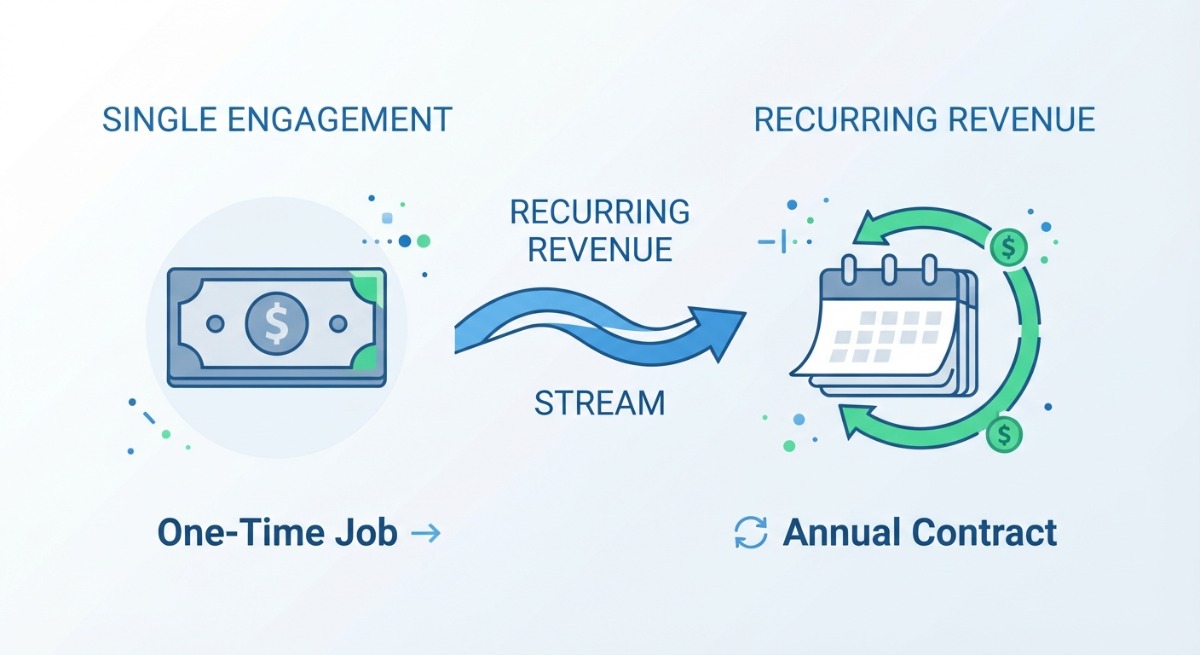
Recurring Revenue vs One-Time Jobs
Market data puts typical HOA pressure washing programs at $3,500 to $12,000 per year per community. Read that as an annuity, not a job: the same community, washed on schedule, invoiced on schedule, renewed with a signature instead of a sales process.
The compounding is the real prize. Three communities on annual programs is a five-figure floor before the season starts, plus route density, because association work clusters buildings and flatwork in one place.
The Trade-Offs Nobody Mentions
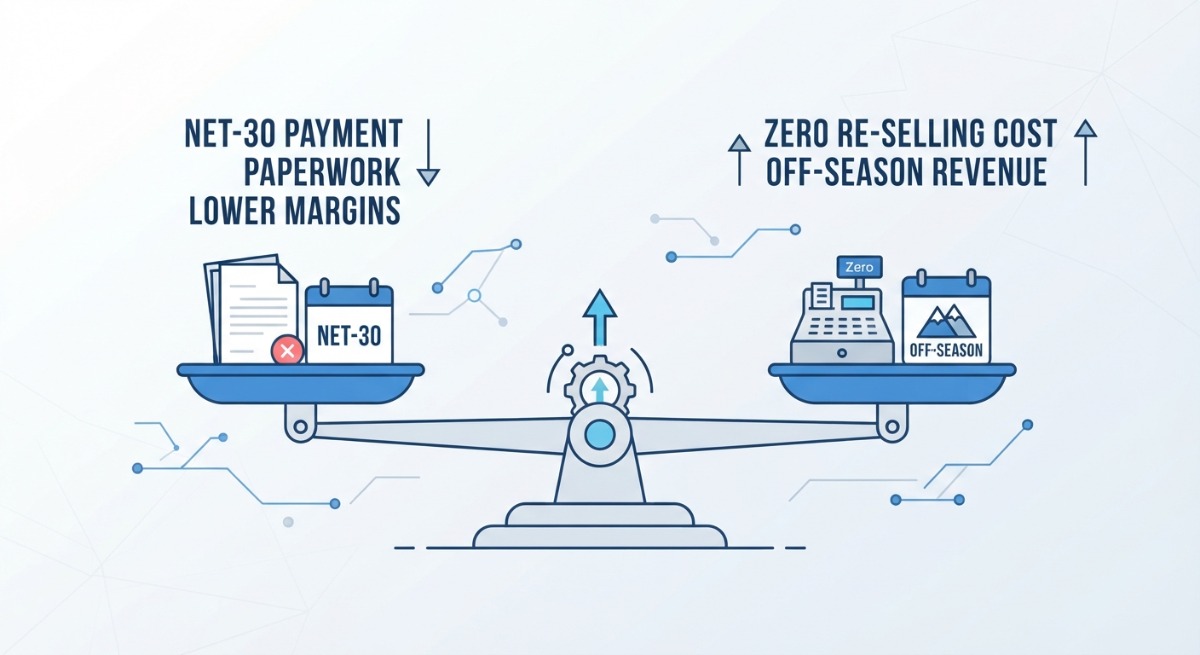
Honesty first. Commercial work pays net-30 instead of same-day, the sales cycle runs weeks to months instead of a driveway conversation, the paperwork is real, and per-visit margins usually sit below residential. What offsets all of it: the re-selling cost drops to zero once the contract exists, and the revenue shows up in months when residential phones go quiet.
Is Your Company Ready? A 60-Second Self-Check
Four questions. Do you carry commercial-grade insurance, or could you within a month? Can your crew absorb scheduled work without dropping residential? Could you float 30 to 60 days of receivables without panic? And would your website survive a property manager’s five-minute inspection without embarrassing you? If two or more answers are no, fix those before your first bid, because the bid will surface them anyway.
Who Actually Buys Commercial Pressure Washing in Connecticut?
This is the part residential owners are never taught. The buyer is not “a business.” It is one of four specific people, and each buys differently.
Property Management Companies
For most mid-size Connecticut associations and many commercial buildings, a professional property manager is the gatekeeper. The manager shortlists vendors, collects the paperwork and presents options; the board or owner mostly approves what the manager brings. Win the manager and you are effectively on a roster that spans every property they run. Ignore the manager and your beautiful bid never reaches a vote.
HOA and Condo Boards
Volunteer boards meet monthly, vote on budgets, and answer to their neighbors. Connecticut is dense with them: roughly 4,850 community associations statewide, per CAI Foundation data, with heavy condo concentration in Hartford County towns like Newington, West Hartford, Rocky Hill, Glastonbury and Manchester. Boards move slowly, value low-drama vendors, and renew whoever makes their manager’s life easy.
Facility and Office Managers
Plazas, medical offices, banks, restaurants and gas stations buy directly through a facility or office manager. Decisions are faster here, driven by appearance complaints, lease requirements and inspection dates. These are the best first commercial accounts for a residential company, because a single decision maker signs off.
Municipal and Institutional Buyers
Towns, schools and housing authorities buy through formal RFPs and bid portals. The documents look intimidating and mostly ask for the same things: scope, references, COI, W-9, pricing sheets. Worth pursuing once your paperwork machine runs smoothly, not as your first swing.
Where to Find Them
The CAI Connecticut chapter runs events, an expo and a vendor directory where HOA boards and managers literally go to meet vendors. Add BOMA for commercial buildings, your local chamber, LinkedIn searches for “property manager” plus your county, and the oldest method in the trade: walk the plazas on your existing routes and photograph the signs, because the management company’s name is usually posted on the building.
When Do HOAs and Property Managers Accept Bids?
HOA Budget Season: September to November
Most calendar-year associations set next year’s budget between September and November. A bid that lands in late summer or early fall arrives while money is being allocated; the same bid in January arrives after the money is spoken for. If you remember one date-related fact from this article, it is that HOA budget season is your Super Bowl, and it comes once a year.
What If You Miss the Window?
You do not wait a year doing nothing. Mid-year emergency work (a slip complaint, a graffiti incident, a pre-sale cleanup) gets vendors in the door off-cycle. Ask the manager to put you on the list for the next bid cycle, and offer a small trial: one building, one dumpster pad area, priced fairly. Incumbents get displaced by vendors who were already proven on a small job when the contract came up.
Commercial Buyers’ Cycles
Non-HOA commercial work follows different clocks: the spring refresh before outdoor season, pre-inspection and pre-lease cleanups, and monthly or quarterly programs for food service and fuel sites. These cycles mean commercial outreach works almost year-round, which pairs nicely with the HOA calendar.
What Paperwork Do You Need Before Anyone Will Hire You?
Here is the section that separates the vendors who get replies from the ones who get ghosted.
Insurance: The COI Is the First Filter
A certificate of insurance (COI) is the one-page proof of coverage your insurer issues, and the request for it is often the first filter that quietly eliminates half the bidders. Typical commercial and HOA demands: $1M to $2M per occurrence in general liability, $2M to $3M aggregate, workers comp if you have employees, commercial auto, and the ability to name the association or management company as additional insured on request.
Practical tip that saves a week: have your insurer issue the COI with your exact legal business name, matching your registration, because mismatches stall vendor approval.
Connecticut Registration: The HIC Question
Connecticut has no pressure washing trade license. But exterior cleaning work on residential structures, which is what HOA building washing is, falls under home improvement work, so the CT Department of Consumer Protection Home Improvement Contractor (HIC) registration applies, with registration from $120 per year. Managers increasingly verify vendors on the DCP eLicense lookup before responding, so an active registration is quiet ammunition and a missing one is a quiet disqualification.
The Vendor Packet: One PDF, Ready in an Hour
Assemble one PDF and keep it current: W-9, COI, HIC registration, three references, sample service report, a page of before-and-after photos. When a manager asks for documents, sending the packet within the hour signals exactly the professionalism the contract requires. Vendors who take a week to find their W-9 are telling the manager how the service will go.
A Note on Wastewater and Runoff
Commercial surface cleaning raises runoff questions residential work rarely does. EPA guidance and CT DEEP expectations come down to one principle: wash water does not go to the storm drain untreated. Know your recovery and containment answer before a board asks, because they ask the moment one resident complains, and the vendor with a calm answer keeps the contract.
How to Bid a Commercial or HOA Pressure Washing Job
Measure and Price by Production, Not by Guess
National market ranges for reference, which you must adjust for Connecticut labor and travel costs: flatwork commonly runs $0.08 to $0.25 per square foot, building washing and vertical surfaces $0.30 to $0.55, and specialty surfaces like gas station pads up to $0.75, with minimum visit charges of $350 to $500. Measure the actual square footage, know your hourly production rate, and price from those two numbers rather than from nerves.
Price the Annual Program, Not the Visit
Boards budget annually, so annual numbers fit how they think. Bundle the building wash, flatwork, dumpster pads and common areas into one yearly figure with a defined visit schedule, and propose 3 to 5 percent annual escalators for multi-year terms. A $9,000 annual program reads as a budget line; four separate visit quotes read as four chances to say no.
What a Winning Bid Document Contains
One page of scope with explicit exclusions, the surface list with square footage, visit frequency, access and water source notes, proof of insurance attached, references, photos of comparable work, and payment terms. The exclusions matter as much as the inclusions, because scope clarity is what protects you when a board member asks why the retaining wall was not washed.
How to Respond to a Formal RFP Without a Proposal Writer
Read the submission checklist twice before writing anything. Answer in their order, using their headings. Never leave a required field blank, and include the COI even when it is listed as optional. RFPs are graded by checklist, not by eloquence, and complete beats clever every time.
Handling the Lowball Competitor
Do not match the price. Attack the scope instead: ask the manager whether the low bid specifies surfaces, frequency, insurance limits and runoff handling, because vague scope is where cheap bids hide their change orders. Managers have been burned before; naming the risk calmly does the selling for you.
Net-30, Deposits, and Getting Paid Without Awkwardness
What Net-30 Actually Means for Your Cash Flow
Net-30 means payment is due 30 days after your invoice, and in practice some checks arrive at day 45. Plan the float deliberately: know how many weeks of fuel, payroll and insurance you can carry, and cap how much of your monthly revenue sits in receivables while you build a cash cushion. Commercial work does not pay worse; it pays later, and the companies that fail at it are the ones surprised by that.
Terms That Belong in the Contract
Invoice on completion, not end of month. Late payment language with a stated fee. And for brand-new commercial accounts where the relationship allows it, a first-job deposit. None of this is aggressive; it is what established vendors already do, and putting it in writing upfront prevents every awkward conversation later.
Invoicing Is a Renewal Tool
Managers renew vendors who make their paperwork easy. A clean, itemized, prompt invoice that matches the contract language gets approved without questions, and the vendor behind it becomes the default choice at renewal time. Sloppy invoicing sends managers back to the market.
What We Learned Getting Mr-Suds in Front of Commercial Buyers in Hartford County
A bid gets you considered. What happens next is the part nobody tells contractors about, and it happens on Google.
The Starting Point
Mr-Suds Power Washing PROs is based in Newington CT and serves 18 Connecticut towns across the Hartford area. Our job was building the presence a commercial buyer would vet.
What Buyers See When They Google the Company
Before any manager returns a bid, they search the company name. What they find for Mr-Suds: 18 live service pages including commercial-facing pages, Newington and Hartford location versions, a Google Business Profile at a 5.0 rating with 39 reviews, and top 3 map pack positions in Newington for 8 of 10 service keywords, the visibility work we documented in our map pack playbook.
Why That Matters for Contracts, Not Just Clicks
Here is the observed behavior: a property manager who receives a bid checks the company online before replying. A company that outranks and outreviews its competitors passes that silent vetting step; an invisible company gets ghosted, and never learns why. Your website is your vendor packet’s first page, whether you sent it or not.
We will be precise about the claim here. The same vetting we prepared Mr-Suds to pass is the vetting your bid will face. That is the proof this section offers, and it is the honest version.
The System Behind It
Behind the visibility sits a white label CRM holding 474 contacts, so no commercial inquiry slips into a forgotten inbox, with fast follow-up and review requests after every job. In commercial work this matters double, because a manager who gets a same-day reply has already learned something about how you will service the account.
If you want to know what a manager sees when they Google you, our digital marketing for pressure washing companies in Connecticut page shows the full system.
Keeping the Contract: How Renewal Beats Re-Bidding
Service Reports and Photo Documentation
After every visit, send a short report with before-and-after photos. The manager forwards it to the board, the board sees value without a meeting, and you become the easy renewal. Vendors who wash silently get re-bid; vendors who document get renewed.
Show Up at the Budget Window With Next Year’s Proposal
Bring next year’s program, with its modest escalator, to the manager before budget season opens. If the renewal is on the table before anyone thinks to open the bid to the market, the market never gets a look.
Grow Inside the Account
Once trusted, the account expands without a sales process: gutters, dumpster pads, graffiti response, seasonal add-ons. The second year of a commercial account is usually worth more than the first, and it costs nothing to sell.
FAQ: Pressure Washing Contracts
How much are commercial pressure washing contracts worth?
HOA programs commonly run $3,500 to $12,000 per year per community, per published market ranges. Larger commercial programs scale with square footage, from roughly $0.08 to $0.75 per square foot depending on surface type, frequency and access. Annual programs with renewal are where the real value compounds.
What insurance do I need for commercial pressure washing contracts?
A general liability policy at $1M to $2M per occurrence is the common floor, often with $2M to $3M aggregate, plus workers comp if you have employees and commercial auto. Expect requests to name the association or management company as additional insured on your certificate of insurance.
Do I need a license to pressure wash commercially in Connecticut?
There is no pressure washing trade license in Connecticut. However, CT DCP Home Improvement Contractor registration applies to work on residential structures, including HOA buildings, from $120 per year, and buyers verify it on the state eLicense lookup before hiring.
When should I bid on HOA pressure washing contracts?
Late summer through fall. Most calendar-year associations set next year’s budget between September and November, so bids submitted ahead of that window land while money is being allocated. Miss it, and ask to be included in the next cycle while offering small off-cycle work.
How do I find property managers who hire pressure washing companies?
Through the CAI Connecticut chapter’s events and vendor directory, LinkedIn searches for property managers in your county, management company websites, and the management signs posted on the properties themselves along your existing routes.
What is net-30 and should I accept it?
Net-30 means payment is due 30 days after your invoice, and it is standard in commercial work. Accept it, plan your cash flow for a 30 to 60 day float, invoice on completion, and include late payment terms in the contract.
How long do HOA pressure washing contracts last?
Commonly one year with renewal. Once trusted, propose multi-year terms with 3 to 5 percent annual escalators, which boards accept because it locks their budget line and saves them a re-bid process.
Can a new pressure washing business get commercial contracts?
Yes. Start with smaller plazas and single buildings where one manager decides, have your insurance and vendor packet ready before outreach, and let residential proof, reviews, photos and a strong profile, substitute for commercial references until you have them.
Get Your Commercial-Ready Presence Audited
Before your next bid goes out, find out what a property manager sees when they Google you. We will audit your website, your profile, your reviews and your map positions against the silent vetting every commercial buyer runs, and show you exactly what to fix, using what worked for Mr-Suds in Newington and Hartford.
Get Your Free Growth Audit
MR Web Solutions, Hartford CT. Call us at +1 860 255 1070.