
Google Maps twenty minutes ago and wants the house washed this week. The property manager has been on your follow-up list for two months and will not sign until budget season. That is the residential vs commercial pressure washing split, and it is not about machines: it is about two funnels that work nothing alike.
Most owners run one funnel and quietly wonder why the other audience never calls. This post maps both, end to end, with the real numbers and the real structure we run for a Connecticut pressure washing company that serves both audiences every week.
What Is the Difference Between Residential and Commercial Pressure Washing?
Residential pressure washing serves homeowners with one-time or seasonal jobs like house washing and driveway cleaning, sold quickly through local search and reviews. Commercial pressure washing serves businesses, HOAs and property managers with larger recurring contracts, sold slowly through bids, relationships and follow-up. They require different marketing funnels, pages and sales processes.
Yes, the technical differences are real too: commercial work runs bigger equipment, higher volume, hot water rigs, larger surfaces and scheduling around business hours. Plenty of articles cover the machines. This one covers the part that decides whether either machine has work tomorrow: how each customer is won.
The Two Funnels Side by Side
Here is the whole article in one table. Everything after it is the how.
| Residential funnel | Commercial funnel | |
| Who buys | Homeowner | Property manager, HOA board, facility manager |
| The trigger | Green siding, a party this weekend | Budget cycle, complaint, inspection, vendor failure |
| Where they look | Map pack, reviews, local search | Referrals and directories, then Google to verify |
| First contact | Call or quick form | Bid request, vendor packet, outreach reply |
| Sales cycle | Hours to days | Weeks to months |
| Who decides | One person, often on the spot | Manager shortlists, board or owner approves |
| Typical ticket | House washes commonly $250 to $500 | Programs commonly $3,500 to $12,000 per year |
| Payment | Card or check on completion | Net-30 invoicing |
| Repeat pattern | Seasonal, if you remind them | Contracted schedule, renewed annually |
| Proof that persuades | Reviews, before and after photos | COI, references, service reports |
| Page that closes them | Service page with prices and photos | Commercial page with compliance and a bid path |
The table condenses what we operate weekly for a real company, with the dollar figures drawn from published market ranges rather than invented averages.
Why Mixing the Funnels Breaks Both
One website voice cannot serve both rows. Homeowner-speak (“sparkling curb appeal for your family home”) reads amateur to a manager vetting vendors. Corporate-speak (“full COI compliance and net-30 terms”) bores a homeowner who wants the green stuff gone by Saturday. And one generic contact form serves neither, because the homeowner needed a phone number and the manager needed a bid request path.
The mixing problem runs deeper than the website. A crew trained to close on the driveway will unknowingly rush a manager who needed three patient touches. A follow-up system tuned for commercial cadence will respond too slowly for the homeowner who is calling your competitor while your auto-reply composes itself. Separate the audiences on separate pages with separate processes, and both start converting.
The Residential Funnel: Won in Minutes, Kept for Seasons
The Buyer and the Trigger
The residential buyer is a homeowner with a visible, emotional trigger: algae creeping up the siding, a graduation party this weekend, or the neighbor’s suddenly spotless driveway making theirs look worse. The need feels urgent the moment it is noticed, which shapes everything about this funnel.
Where They Find You
Four channels carry almost all of it: the Google map pack, organic service pages, Local Services Ads, and referrals. Paid leads have a real price tag: published LSA estimates for this trade report leads around $30 to $65 each, which is exactly why organic map pack presence matters so much. Every lead the rankings bring is one you did not buy, and the full economics live in our cost per lead breakdown.
Notice what all four channels have in common: they run on trust signals you accumulate, not messages you send. Reviews feed the map pack, the map pack feeds calls, finished jobs feed referrals, and referrals still check the reviews before dialing. The residential funnel is a flywheel, and every job either spins it or wastes it depending on whether you asked for the review.
Speed Is the Funnel
Here is the defining mechanic: residential leads are warm for minutes, not days. The homeowner who called you also called two competitors, and commonly reported close rates around 40 percent on warm local leads belong to whoever answers first. We watch this in real accounts: inquiries that wait an hour for a response convert visibly worse than ones answered in five minutes. In residential, your response time is your close rate.
What the Residential Pages Need
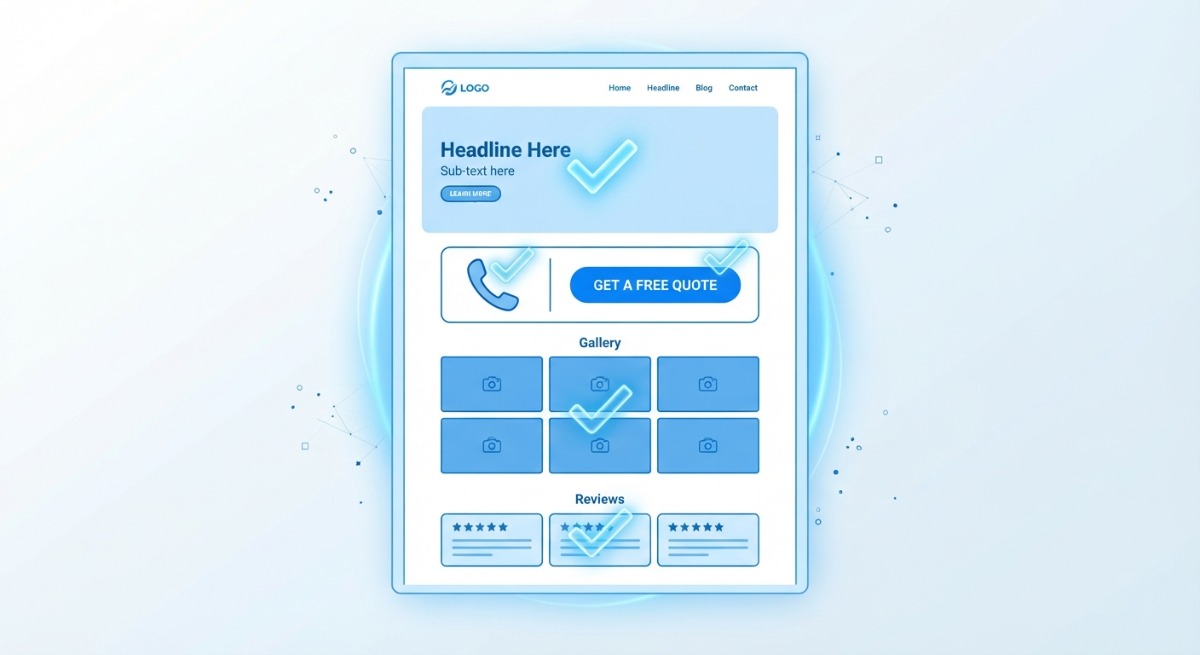
Per-service pages, honest from-pricing, real before and after photos, your live review rating, and a one-tap call button. That page anatomy is its own discipline, and we tore down real examples of it in our guide to pressure washing website examples.
Repeat and Referral
Residential retention is manufactured, not automatic. Annual reminders bring last spring’s house wash back. Neighborhood clustering turns one driveway into a street of them, because the trigger for this funnel is literally visible from next door. And a review request after every job compounds the channel that feeds the whole funnel.
The Commercial Funnel: Won in Months, Kept for Years
The Buyer and the Trigger
The commercial buyer is a role, not a homeowner: property managers, HOA boards, facility and office managers. Their triggers are procedural rather than emotional: a budget cycle opening, a resident complaint, an upcoming inspection, or the current vendor failing. Nobody impulse-buys a $9,000 annual program.
And before you decide your town is too small for this funnel, list what is actually there: retail plazas, dealerships, schools, medical offices, restaurants, gas stations, apartment complexes, managed condo communities. Every one of those has surfaces that get dirty on a schedule and a person whose job includes hiring someone to clean them. Commercial buyers exist everywhere residential buyers do; they are just quieter about it.
Where They Find You
Commercial discovery usually starts with referrals, directories and outreach, but here is the part owners miss: it ends with Google. A manager who receives your bid searches your company before replying, and your rankings, rating and reviews either pass that silent vetting or quietly end the conversation. Residential proof closes commercial deals, even when outreach opened them.
The Long Middle
Between first contact and signed contract sits the stretch that kills most owners’ commercial ambitions: bids, COIs, W-9s, board approvals, and the calendar. For calendar-year HOAs, budget season runs September to November, so a deal opened in June may honestly not close until fall regardless of how good your bid is. Weeks to months is the normal cycle, and knowing that upfront is the difference between patience and quitting.
What the Commercial Pages Need
A dedicated commercial page that speaks manager language: insurance and compliance stated plainly, scheduling flexibility, service reporting, and a direct request-a-bid path instead of a generic contact form. Case-style proof beats homeowner testimonials here, because the manager’s question is not “will my house look nice” but “will this vendor make my job easier.”
Follow-Up Is the Funnel
One email is not a funnel. Commercial deals die from silence in the long middle, and the fix is a CRM cadence: a polite touch every few weeks, a check-in before budget season, a bid that arrives the day the window opens. This is where automation earns its keep, because a busy crew cannot remember a two-month follow-up schedule, and the system can.
The complete playbook for this funnel, from finding the property manager to surviving net-30, is in our guide to winning commercial and HOA pressure washing contracts in Connecticut.
Is Commercial or Residential Pressure Washing More Profitable?
Per-Hour vs Per-Year Math
Per visit, residential often wins: published residential rates commonly run $0.20 to $0.50 per square foot, while commercial flatwork commonly runs $0.08 to $0.25. Per year, commercial usually wins anyway, because a contracted community washed on schedule generates revenue with zero re-selling cost, while every residential dollar must be re-earned through the funnel.
Run the shape of it with round numbers. A $400 house wash earned through the residential funnel had a lead cost, a response race and a quote behind it, and next spring the whole sequence runs again. A $6,000 annual community program earned once renews with a signature, and its second year has no acquisition cost at all. Lower rate, higher lifetime, and the lifetime is what compounds.
Those per-square-foot figures are national benchmarks; adjust them for Connecticut labor and travel before quoting anything.
Cash Flow Contrast
Residential pays the day of the job. Commercial pays net-30, sometimes stretching to 45. A small operation’s mix should respect that: enough same-day residential to fund payroll and fuel while the commercial receivables float. Cash flow, not preference, is what should set your early ratio.
The Honest Recommendation
Residential pays today and funds the patience commercial requires. Most healthy companies run both deliberately, leaning on residential volume while commercial contracts stack season over season. The trap is not choosing one; the trap is running both through one funnel and doing neither properly.
How We Run Both Funnels for Mr-Suds in Connecticut
The same week can hold a Newington house wash booked from the map pack and a follow-up email to a manager who will not decide until budget season. Here is how both tracks actually run.
The Setup
Mr-Suds Power Washing PROs serves 18 towns across the Newington and Hartford CT area, and one of our own co-owners owns the company, so we build and test both funnels with full transparency and nothing to exaggerate.
The Residential Track
The proven one. Eighteen service pages in the generic plus Newington plus Hartford structure. Google Business Profile work that reached the Newington map pack top 3 for 8 of 10 service keywords, with number 1 positions for house washing, soft washing and fence washing. A 5.0 rating across 39 reviews doing the closing on every profile visit, and ads feeding extra lead flow in season. This track produces measurable motion in months, and its results are checkable in a Newington search today.
The Commercial-Facing Track
The built system. Dedicated commercial-facing pages, and the white label CRM holding 474 contacts, so no inquiry or long-cycle prospect goes cold in an inbox. Follow-up sequences do the patient work a busy crew cannot: the check-ins, the pre-budget-season touches, the instant response when a manager finally replies.
We will be precise about the asymmetry, because it is the honest version: the residential track has proven, checkable results; the commercial track is the system running and compounding, built exactly for the long cycles this article describes.
What Running Both Taught Us
The funnels share a brand and a truck and nothing else. The residential funnel rewarded us in months; the commercial funnel is built for quarters. And the biggest lesson for any owner reading this: people who judge commercial by residential timelines quit exactly when the funnel is about to pay. The full system behind both tracks is on our digital marketing for pressure washing companies in Connecticut page.
Build Order: Which Funnel First, and How to Add the Second
If You Are New
Residential first, no debate. It generates cash this month, builds the review base, and creates the proof both funnels need. While you work those routes, collect commercial targets the free way: photograph the management signs on every plaza and complex you drive past, and keep the list.
If Residential Is Working
Add commercial deliberately, in this order: build the dedicated commercial page, assemble the vendor packet (COI, W-9, references, sample report), and work a 10-account outreach list with a follow-up cadence, all before spending a dollar on commercial lead vendors. Ten well-followed accounts beat a hundred one-touch emails.
Why the packet before the outreach: the first thing an interested manager asks for is documents, and the vendor who sends a complete PDF within the hour has just demonstrated exactly the reliability the contract requires. Assembling it after the ask means a week’s delay at the exact moment speed was the sales pitch.
The Shared Foundation
Both funnels sit on the same base: rankings, reviews and site structure. The homeowner finds you through it; the manager verifies you through it. Which means the foundation work is never wasted on either audience, and the full build order for that foundation is our complete guide to pressure washing SEO.
One calendar note ties it together for a northern market. Residential demand peaks April through November, and HOA budget season runs September to November, which means late summer is the one stretch when both funnels demand attention at once. Plan for it: your commercial bids go out while your residential schedule is fullest, and the companies that stack winter contracts are the ones that did commercial paperwork during their busiest residential weeks.
FAQ: Residential vs Commercial Pressure Washing
What is the difference between residential and commercial pressure washing?
Residential serves homeowners with one-time or seasonal jobs sold quickly through local search and reviews. Commercial serves businesses, HOAs and property managers with recurring contracts sold slowly through bids and follow-up. They need different funnels, pages and sales processes.
Is commercial pressure washing more profitable than residential?
Per visit, residential often earns more per square foot. Per year, commercial usually wins through recurring contracts commonly worth $3,500 to $12,000 per community, because contracted work carries zero re-selling cost once won.
How do I get residential pressure washing customers?
Map pack presence, per-service pages, reviews and fast response. Most residential leads choose whoever answers first, so response speed functions as your close rate. Reminders and neighborhood clustering turn one-time jobs into seasonal repeats.
How do I get commercial pressure washing clients?
Identify the property manager or facility manager, meet vendor requirements like a certificate of insurance and W-9, bid during budget season, and follow up on a schedule for weeks. One outreach touch is not a funnel; the cadence is.
How long does it take to close a commercial pressure washing deal?
Commonly weeks to months. HOA decisions often wait for the September to November budget window regardless of when you first made contact, so plan the pipeline in quarters, not days.
Should my pressure washing website target homeowners or businesses?
Both, on separate pages. Homeowners need photos, prices and reviews with a one-tap call. Managers need compliance details, scheduling, reporting and a bid request path. One generic page serves neither audience well.
Can a small pressure washing company do both residential and commercial?
Yes, and most healthy ones do. Run residential for cash flow and proof while building the commercial pipeline behind it, with separate pages and separate follow-up cadences so neither funnel leaks into the other.
Do commercial clients check Google reviews?
Yes. Managers verify vendors online before responding to bids, so your residential rating and reviews actively support commercial sales. A strong profile passes the silent vetting; an invisible one gets ghosted.
Get Both Funnels Audited
We will map your current setup against both funnels: your residential visibility and response flow, and your commercial page, packet and follow-up system, then show you in writing which one is leaking and what to build first. Same two-track system we run for Mr-Suds, applied to your market.
MR Web Solutions, Hartford CT. Call us at +1 860 255 1070.