By the MR Web Solutions team, Hartford, CT
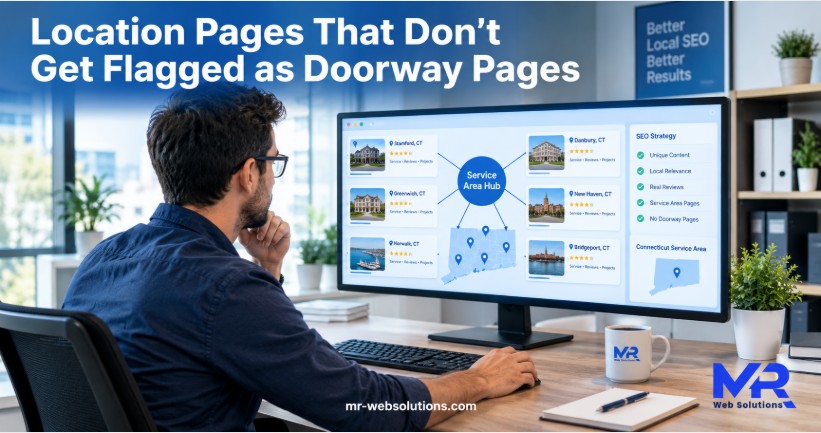
It is a planning session at our office on Wethersfield Ave. On one side of the screen is the Mr-Suds service list: pressure washing, house washing, soft washing, deck and patio, fence, pool deck, roof and gutter cleaning. On the other side are its 18 service towns, from Hartford and Newington out to Middletown, Glastonbury, Simsbury and Wallingford.
Multiply them and you get 144 possible location pages.
It is tempting. Every page looks like one more chance to show up for "house washing Wethersfield." So we pulled up two of those imagined pages side by side, Newington and Wethersfield, and asked one honest question.
Other than the town name, what would be different?
That question is the line between location pages that help and doorway pages that put a site at risk. This article is how we answer it on real projects, for Hartford County towns and beyond. It is written for the home service industries we work with: pressure washing, cleaning, roofing, painting, HVAC and more.
The short answer: when is a location page a doorway page?
A location page is genuine when a searcher in that town gets something your other pages cannot give them: jobs you did there, reviews from neighbors, local rules or pricing, and the crew who shows up. A doorway page swaps the town name into one template. Build fewer pages backed by proof, and merge the rest.
The URL and the town in the title do not decide it. What the visitor finds on the page does.
What does Google actually say about doorway pages?
Google's rules are public. It helps to read them in Google's own words, then translate them into contractor language.
How does Google define doorway abuse?
Google's spam policies define it this way: "Doorway abuse is when sites or pages are created to rank for specific, similar search queries. They lead users to intermediate pages that aren't as useful as the final destination."
The example that matters most for contractors is this one: "Having multiple domain names or pages targeted at specific regions or cities that funnel users to one page."
"Funnel" is the key word. A doorway page exists only to catch a search and push the visitor somewhere else, usually the homepage or a contact form. It does not answer anything on its own.
What changed in 2024 with scaled content abuse?
On March 5, 2024, Google announced a core update along with new spam policies in its post on the March 2024 core update and new spam policies. One of them was scaled content abuse.
Google's policy defines it: "Scaled content abuse is when many pages are generated for the primary purpose of manipulating search rankings and not helping users." It adds that this applies "no matter how it's created."
That last part matters. A human copywriter rewriting the same page 30 times is still scaled content. Google even lists "synonymizing" among its examples, meaning rewording the same content, which is exactly what spun city pages do.
The update finished rolling out on April 19, 2024. Google told Search Engine Land that searchers would now see 45% less low quality, unoriginal content in results.
What happens to a site that gets caught?
There are two possible outcomes.
- Algorithmic demotion. The pages, or the whole site, quietly lose visibility.
- A manual action. A person at Google reviews the site and applies a penalty you can see in Search Console.
Google's manual actions page lists "Thin content with little or no added value" as a manual action, and names doorways as an example. To recover, you fix the pages and file a reconsideration request. Google asks you to "Provide examples of bad content that you removed and good content that you added."
What is the difference between a doorway page and a genuine location page?
The difference is not the URL. It is what the visitor gets.
| Signal | Doorway page | Genuine location page |
|---|---|---|
| Content | Same template, town name swapped | Built from that town's jobs, reviews and conditions |
| Photos | Stock or the same gallery on every page | Real job photos from that town |
| Reviews | Same testimonials everywhere | Reviews from customers in that town |
| FAQs | Generic | Questions people in that town actually ask |
| Purpose | Push the visitor to the homepage or form | Answer the visitor fully, then offer a call |
| Linking | Orphaned or buried in a footer list | Linked from a service area hub and related service pages |
| Schema | Fake address per town | Service schema with areaServed, real address only |
| Count | Every town in a radius | Towns with real work and demand |
Do I need an office in a town to have a page for it?
No. Google's doorway wording targets funneling and sameness, not addresses. A service area business can have pages for towns it genuinely serves.
What you must not do is invent an address. No fake office in Wethersfield to rank there.
You will see advice online that says "one page per physical location." That rule fits retail chains with storefronts. It does not fit a Newington pressure washer who drives to Hartford every week. That contractor can have a Hartford page, as long as it is about real work in Hartford.
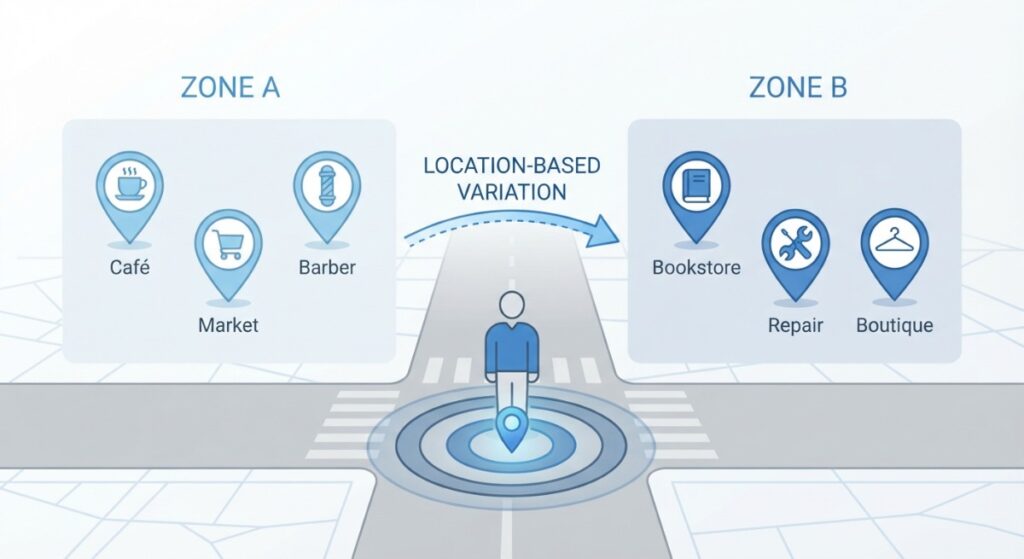
What makes each location page unique enough?
When we built service and city pages for 24/7 Mobile Tyre Services, a mobile tyre fitting company based in Glasgow, every page had to be built from what is actually different in that city.
Edinburgh pages dealt with cobbled setts and tram tracks. Hamilton pages talked about the M74 corridor. Aberdeen pages covered the offshore rotation pattern, with drivers leaving cars parked for weeks. And for cities far from the Glasgow base, we refused to promise arrival times we could not verify.
That is the mindset. Here is the framework.
What local proof should every location page carry?
We call this the local proof inventory. Every location page should carry at least three of these:
- Local jobs and photos: before and after shots from jobs in that town. Name the street type or neighborhood, never a client's address.
- Reviews from that town: pull Google Business Profile reviews where the customer mentions the town or the job.
- Local FAQs: the questions people from that town actually ask on calls.
- Area specific rules or pricing factors: for example, exterior changes in the Old Wethersfield Historic District that are visible from the street need a Certificate of Appropriateness. Water and sewer rules can matter too. Hartford, West Hartford, Wethersfield and Newington are all member towns of the Metropolitan District Commission (MDC).
- The team or crew: who actually covers that town, and from where.
- Service radius and directions: for example, a Newington crew reaching Wethersfield along the Berlin Turnpike, or Hartford by Interstate 84.
- Local schema: Service markup with areaServed set to that town.
- A local conversion path: the town named in the call to action, with a tracked phone number or form.
Most of this comes from work you have already done. Your phone's camera roll and your review history are the raw material.
How much of the page needs to be different?
Google does not give a percentage. BrightLocal's location pages guide suggests trying to make more than half of the page unique to that location, and calls 40% to 60% a safe enough margin. Treat that as a third party guideline, not a Google rule.
On the Scotland pages, our rule was stricter in spirit. Sibling pages for the same service had to differ substantially. On the Edinburgh pages, Glasgow appeared only in the business address.
A short block explaining the service itself can repeat across pages. That is fine, as long as the local material carries the page.
What does not count as unique?
- Synonym swaps: "fast, reliable" on one page and "quick, dependable" on the next
- Reordered paragraphs: the same content in a different order
- A town history paragraph copied from a website about the town
- Weather paragraphs that apply to all of Connecticut
- A list of ZIP codes
All of these are the "synonymizing" pattern Google names in its scaled content policy. They change the words without changing what the visitor learns.
Google's guide to creating helpful, people first content suggests asking "Who, How, and Why" about your content. For a location page, the honest "why" should be "to help someone in this town," not "to rank for this town."
Is it OK to use AI to write location pages?
Google's scaled content policy names "Using generative AI tools or other similar tools to generate many pages without adding value for users."
The tool is not the problem. The sameness is. AI can help you structure and edit a page, but the local proof has to come from your jobs, your photos and your customers. We cover the wider shift in our post on how AI Overviews are changing local search.
How many towns should you build location pages for?
Fewer than you think, to start. Pages can always be added as the proof builds up. Our guide to ranking in your service area covers the wider SEO picture.
Which towns pass the test?
Ask four questions about each town:
- Have we done paid jobs there?
- Do we have photos and at least one review from there?
- Do people search for our service with that town name?
- Can we reach it within our real service radius?
A town that fails two of the four stays on the hub page for now.
Your Google Business Profile should tell the same story. Google's service area rules allow up to 20 service areas, and say the overall area shouldn't be more than about two hours of driving from your base. We explain how service areas affect the map pack in our guide to ranking in the Google Map Pack.
Here is a typical scenario. A Hartford County owner cleans in Newington, Wethersfield and Rocky Hill every week, and has done two jobs in Simsbury.
| Town | Paid jobs | Photos and review | Search demand | Within radius | Result |
|---|---|---|---|---|---|
| Newington | Yes | Yes | Yes | Yes | Own page |
| Wethersfield | Yes | Yes | Yes | Yes | Own page |
| Rocky Hill | Yes | Yes | Yes | Yes | Own page |
| Simsbury | Two jobs | Photos, no review yet | Some | Yes | Hub for now |
Simsbury is not ruled out forever. It just has not earned its page yet.
Should small neighbouring towns share a page?
Often, yes. For Premier Contract Cleaning, a commercial cleaning client in Dublin, Ireland, we did not build one page per postcode. We paired neighbouring business districts on one showroom cleaning page each: Sandyford and Leopardstown, Dublin 2 and the Docklands, Dublin 1 and the IFSC, Dublin 4 and Ballsbridge.
Each pair shares real business character. One strong page serves both areas better than two thin ones.
The same logic works in Connecticut. Rocky Hill and Cromwell, or Berlin and East Berlin, can share a page if the jobs and homes there look alike.
What does this look like for a Hartford County contractor?
Back to Mr-Suds. Eight services across 18 towns gives 144 possible pages. Here is how we think about it:
- Newington, the home base, gets full pages, because that is where the jobs, reviews and history are.
- Hartford, the expansion market, already has its own pages for pressure washing and soft washing.
- Towns with a run of real jobs get their own page next, one at a time, as proof builds up.
- Everything else is listed on a service area hub, with a short, honest paragraph per town.
The goal is not 144 pages. It is the right pages, each one able to answer "what is different here?" Our page on marketing for pressure washing companies in Connecticut shows how this fits into the full system.
If you're not sure which of your towns deserve a page, we'll look at your jobs, reviews and search data and tell you honestly. See our local SEO in Hartford work, or book a free growth audit.
How should location pages link together?
What is a service area hub page?
A hub is one "Areas We Serve" page that links to every town page. It also includes a short, real paragraph for towns that do not have their own page yet.
This matters for more than navigation. One of Google's doorway examples is "Creating substantially similar pages that are closer to search results than a clearly defined, browseable hierarchy." A clear hub with town pages under it is that hierarchy.
How should town pages link to service pages and back?
- Town pages link to the relevant service pages.
- Service pages link to the two or three strongest town pages.
- Neighbouring towns link to each other where it helps the visitor, like "also serving Rocky Hill."
- Breadcrumbs show the path: Home, Areas We Serve, Wethersfield.
Keep town pages out of a 60 link footer. A long list of town links at the bottom of every page is one of the clearest doorway signals there is.
Should location pages go in the main menu?
A single "Areas We Serve" link in the main menu is enough. Individual towns sit under it on the hub.
What should you do with existing thin city pages?
Many owners already have a stack of copy and paste town pages, built by a previous agency or by themselves. You are not alone, and there is a way out.
For 24/7 Mobile Tyre Services, the site already had short town pages for Ayr, Wishaw, Stirling, Falkirk, Perth and Carlisle. We replaced them with full location pages. In a later batch, we left Perth alone, because a strong Perth page already existed. We also flagged two duplicate Edinburgh URLs that needed one canonical version and a 301 redirect. You can see more of the projects we've built.
Our founder, Shohanur Reza, sets the tone for how we handle this: we would rather build six pages that bring calls than sixty that put the whole site at risk. And when a page is not worth building, we tell the client so.
How do you audit the pages you already have?
Put every town page in a spreadsheet with these columns:
- URL
- Impressions and clicks from Google Search Console
- Calls and forms tracked to that page
- Jobs done in that town
- Photos and reviews on hand from that town
Within an hour, it becomes clear which pages have something to build on and which do not.
Should you rewrite, consolidate or noindex?
Two terms first. A 301 redirect permanently sends visitors and search engines from one URL to another. A canonical tag tells Google which of two similar URLs is the main one.
| Situation | Action | Why |
|---|---|---|
| Real jobs and some traffic, thin copy | Rewrite in place, keep the URL | Keeps existing signals, adds proof |
| Two pages for the same town or near identical towns | Consolidate with a 301 into the stronger page | Google calls a redirect a strong canonical signal |
| No jobs, no traffic, town outside your real radius | Remove and 301 to the hub | Nothing to save, and the hub still serves the visitor |
| Useful for customers (ads, print) but not for search | Noindex, keep live | Drops from search but stays usable |
Google's guide to consolidating duplicate URLs calls redirects "A strong signal that the target of the redirect should become canonical."
One technical note on noindex. Google's noindex guide says: "For the noindex rule to be effective, the page or resource must not be blocked by a robots.txt file." If robots.txt blocks the page, Google never sees the noindex.
Do you need to file a reconsideration request?
Only if Search Console shows a manual action. If there is no manual action, fix the pages and let Google recrawl them.
What schema should a location page use?
Service schema with areaServed for service area businesses
For a town page where you serve customers but have no office, use Service schema with the areaServed property. Schema.org defines areaServed as "The geographic area where a service or offered item is provided." It accepts a Place, an AdministrativeArea, a GeoShape or plain text.
Set it to the town the page covers, such as Wethersfield, as a City or AdministrativeArea.
When to use LocalBusiness schema
Google's LocalBusiness documentation lists name and address as required, and describes the address as "The physical location of the business."
So use LocalBusiness on the page for your real office. For Mr-Suds, that is Newington. Never add a fake address per town to make LocalBusiness fit.
Add BreadcrumbList markup on every town page too. We cover how schema helps Google understand your brand in our post on entity SEO for contractors.
How do you tell if a location page is working?
A location page is working when it brings calls, not just visits. Track three things:
- Calls and forms per page. Use a tracked number or a form source field, so the CRM records which page each lead came from. Our GoHighLevel setups record the page source on every form lead.
- Search Console impressions for "service + town" searches, like "house washing Wethersfield."
- Reviews that mention the town, which feed back into the page itself.
After a few months, you can see which pages earn their place. Pages that bring nothing after a fair run go back on the list for a rewrite, a merge or removal.
Location page checklist before you hit publish
- At least three local proof types
- One photo set from jobs in that town
- At least one review from that town
- Local FAQs from real calls
- Real driving or radius information
- Service schema with areaServed
- Linked from the hub and from two service pages
- No fake address anywhere
- A tracked call to action that names the town
If a page cannot tick most of these, it is not ready yet. Keep the town on the hub until it is.
Frequently asked questions about location pages
Are location pages considered doorway pages?
Not by default. Location pages become doorway pages when they are near copies made only to rank and funnel visitors elsewhere. Pages built on real local work, with jobs, photos, reviews and details specific to that town, are what Google wants to show for local searches.
How many location pages should a small contractor have?
As many as there are towns that pass the test: real paid jobs, photos and reviews, search demand, and a realistic drive. For most Hartford County owner operators, that is a handful of pages to start. You can add more as proof builds up in other towns.
Can I have a city page without an office there?
Yes, if you genuinely serve that town. Google's doorway policy targets pages that funnel visitors and repeat the same content, not pages for towns without an office. Never list a fake address. Use Service schema with areaServed instead of LocalBusiness for those pages.
How much of each page should be unique?
Google does not set a percentage. BrightLocal suggests making more than half of each page unique to that location. Our working rule is that the local material should carry the page, with only a short shared block explaining the service itself.
What is scaled content abuse?
It is a Google spam policy introduced in March 2024. Google defines it as many pages generated mainly to manipulate search rankings rather than help users, no matter how they are created. That includes pages written by hand, rewritten with synonyms, or produced with AI without adding real value.
Should I delete my old city pages?
Not automatically. Rewrite pages that have real jobs and some traffic. Consolidate duplicates or near identical towns into the stronger page with a 301 redirect. Remove pages with no jobs or traffic and redirect them to your hub. Noindex pages you keep only for ads or print.
Do my GBP service areas need to match my pages?
They should tell the same story. If your website has pages for towns you never list on your Google Business Profile, or the reverse, it sends mixed signals. Google allows up to 20 service areas, within about two hours of driving from your base.
What schema should a service area page use?
Use Service schema with areaServed set to the town the page covers. Save LocalBusiness schema for the page about your real office, because Google's documentation requires a physical address for it. Add BreadcrumbList markup to every town page as well.
How long until rewritten pages recover?
There is no fixed timeline. It depends on how quickly Google recrawls the pages and how much stronger they are. Watch Search Console impressions for your "service + town" searches over the following weeks, rather than expecting results by a set date.
Want us to look at your location pages?
We have built and cleaned up location pages for pressure washing, cleaning and mobile tyre businesses in three countries. We will tell you straight which of your town pages are worth keeping, which should be merged, and which towns have not earned a page yet.
Book a free growth audit, or see our website design in Hartford work. And if your town pages start bringing calls you cannot answer from a job site, try our AI Receptionist with a 14 day free trial.
Call +1 (860) 255 1070, or visit us at 375 Wethersfield Ave, Hartford, CT 06114.