By the MR Web Solutions team, Hartford, CT
We are at our office on Wethersfield Ave, going through a cleaning client's inquiry log with the team. Most messages are from homeowners. "How much for a deep clean?" "Do you have Saturday openings?"
The few from business buyers read differently. They are short and specific. And they ask for paperwork before they ask for price.
We saw the same thing with Mr-Suds in Newington. When a Hartford County property manager or HOA manager got in touch, the first ask was a certificate of insurance. And by then, they had already looked at the website and the Google profile.
Cleaning contracts with property managers are won the same way. Managers vet you quietly, before they ever reply. This guide covers who to target in Connecticut, what managers check, what turnovers pay, how vendor platforms work, and how to keep the account once you have it.
If you run a pressure washing company, our separate guide on commercial and HOA pressure washing contracts in Connecticut covers that side.
How do you get cleaning contracts with property managers?
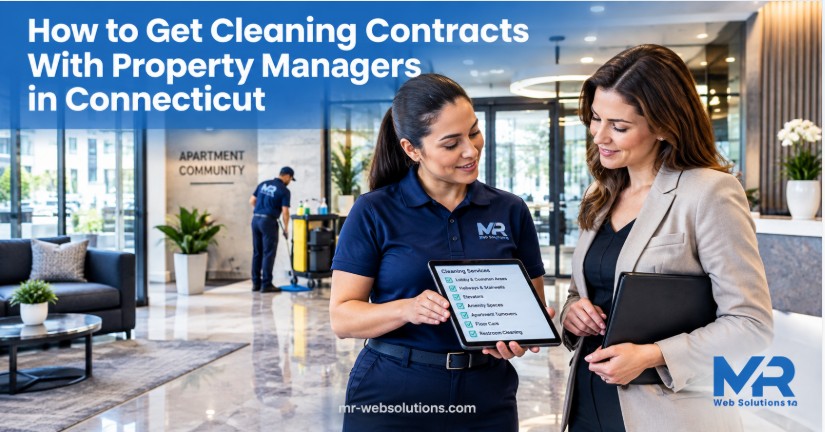
To get cleaning contracts with property managers, get your COI, W9 and business registration ready, build a website page written for managers, and list the property management firms and HOAs in your area. Contact the right manager, offer a trial turnover, deliver fast with photo proof, and follow up until you are their default vendor.
- Get your paperwork ready.
- Build a page for managers and complete your Google profile.
- Make a target list.
- Reach out the right way.
- Do a trial turn with a photo report.
- Follow up and earn the renewal.
What cleaning work do property managers actually buy?
Managers buy cleaning in their own language. Knowing these terms helps you sound like a vendor, not a residential cleaner trying something new.
What is turnover or move out cleaning for rentals?
A turnover clean, also called a unit turn or move out cleaning, is the deep clean of a vacant unit between residents. It usually covers:
- Kitchen, with appliances cleaned inside and out
- Bathrooms
- Cabinets and drawers
- Floors and baseboards
- Windows and window tracks
It sits inside a "make ready" sequence along with paint and maintenance repairs. The cleaner usually goes last. So when paint runs late, the cleaning window gets squeezed, and the manager still needs the unit ready for move in.
What does common area cleaning include?
Common area cleaning covers the shared spaces in a building:
- Lobbies and mail areas
- Hallways and stairwells
- Laundry rooms and trash rooms
- Fitness rooms
It is usually recurring, weekly or every other week. In Connecticut, winter adds work. Salt and slush get tracked into lobbies from December through March, which can mean extra visits during bad stretches.
When do managers need post construction cleaning?
After a unit renovation, a new building or repairs after water damage. Post construction cleaning is dust heavy and a higher ticket.
Managers often buy it from the vendor who already handles their turnovers, because that vendor already knows the property.
What about offices in mixed use buildings?
Many management companies also run mixed use buildings: apartments upstairs, shops or offices below. You see this around downtown Hartford, West Hartford Center and Glastonbury.
One good relationship can open both residential turns and commercial office cleaning in the same portfolio.
Who hires cleaning companies in Connecticut and where do you find them?
Which property management companies should you target first?
Start with mid size firms that manage scattered rentals and small apartment buildings across Hartford County. They have a steady flow of turnovers and fewer locked in vendor contracts than large institutional owners.
Build your list from their own websites and Google profiles. Note the towns they manage in, the type of property, and who handles maintenance or vendors.
Do apartment communities hire their own cleaners?
Larger communities usually have an on site community manager and a maintenance supervisor. When units turn, one of them calls the cleaner.
You can often find the community manager's name on the leasing office page or on LinkedIn. That person, not a general inbox, is who you want to reach.
How do HOAs and condo associations buy cleaning?
Common area cleaning for an HOA or condo association is usually approved by the board, through its community manager. Boards set budgets on a yearly cycle, so timing matters.
We cover that timing in the HOA budget season section of our pressure washing contracts guide, and the same calendar applies to cleaning.
Which Connecticut associations put you in the room with managers?
Three groups bring property managers and vendors together in Connecticut:
- Connecticut Apartment Association (CTAA), based in West Hartford, is an affiliate of the National Apartment Association. It offers Business Partner Members, and all memberships are company based.
- IREM Connecticut Chapter 51, part of the Institute of Real Estate Management, has been active in Connecticut since 1977. It runs an Industry Partners program.
- CAI Connecticut, the Connecticut chapter of the Community Associations Institute, has over 1,200 members, including over 240 property managers and over 150 businesses, according to its April 2026 magazine. Its annual Conference and Expo is held in March.
Our advice: attend one event as a guest before paying for membership. See who is in the room first.
What do property managers check before they reply to you?
This is the part most cleaning owners never see. When a manager does not reply, it is often because you did not pass a check you did not know about.
Why is the certificate of insurance the first filter?
A certificate of insurance, or COI, is a one page summary of your coverage from your insurer. Managers usually ask for it before anything else.
RealPage's vendor credentialing page lists what these programs typically require:
- A COI with required limits
- General liability, workers compensation, and auto liability if applicable
- Trade licenses, as required by state
- A W9 for vendor setup and tax reporting
- Background checks, if required
Many managers also ask to be named as "additional insured" on your policy. That means the management company, and often the property owner's company, are covered under your general liability for your work at their property.
Do not guess the limits. Ask the manager for their exact requirements and get your insurer to issue the COI to match.
What paperwork goes in a cleaning vendor packet?
Keep everything in one PDF, ready to send the same day:
- [ ] Certificate of insurance
- [ ] W9
- [ ] Connecticut business registration
- [ ] Connecticut sales and use tax permit, if it applies to you
- [ ] Three references
- [ ] A sample photo report from a past job
- [ ] A rate sheet
- [ ] A service area map
- [ ] An emergency contact number
A manager who asks for documents and gets them in an hour remembers you.
Do managers really Google you first?
In our experience, yes. With Mr-Suds, Hartford County managers looked at the website and Google profile before they responded. We have seen the same pattern with business buyers on our cleaning client sites.
Here is what they look for:
- A business name that matches the name on your COI
- Real photos of your work, not stock images
- Reviews that mention reliability and showing up on time
- A page that speaks to property managers, not just homeowners
Your Google Business Profile and local SEO are part of your vetting packet, whether you planned it or not. Buyers also see AI answers in search now, which we cover in our post on how AI Overviews are changing home service search in Connecticut.
How fast do managers expect a unit turned?
Fast. The National Apartment Association's turnover guide says many companies use seven working days as an average guideline to turn an apartment. It adds that management groups frequently expect five working days, and at times only three.
That is for the whole turn, including paint and repairs. A cleaner who can finish within 24 to 48 hours of notice makes the manager's whole schedule easier.
How do you get on vendor portals and credentialing platforms?
Many larger management companies will not pay a vendor until that vendor is set up on their platform.
What are vendor credentialing platforms?
They are services that check vendors meet a manager's requirements before working at a property.
RealPage Vendor Credentialing, formerly called Compliance Depot, is one example. RealPage says it screens vendors with background checks, insurance review and financial status evaluation. The typical requirements are the COI, licenses, W9 and background checks listed above.
Once you pass, you are on the manager's approved vendor list.
What does Yardi VendorCafe ask vendors to do?
Yardi VendorCafe is another common platform. Through it, vendors can:
- Upload documents such as insurance certificates
- Receive expiration alerts
- Upload invoices
- Monitor invoice approvals
The expiration alerts matter. If your COI lapses on the platform, your work orders and payments can stop until it is updated.
What if the manager uses AppFolio or Rent Manager?
Many smaller Connecticut firms dispatch work orders straight from their property management software, such as AppFolio or Rent Manager.
During onboarding, ask three questions:
- How will work orders reach us?
- How should we attach photos?
- How do you want invoices sent?
Every firm sets this up differently. Asking early saves weeks of chasing payments later.
Do vendors pay to be credentialed?
Sometimes. Fees vary by program and are usually set by the platform the manager chooses. Ask the manager before you sign up, so there are no surprises.
How much should you charge property managers for turnover cleaning?
What are the public benchmarks per turn?
Lula's September 2026 make ready cost guide gives the most useful public numbers we have found:
- Cleaning runs about $150 to $400 per turn.
- Managers using a single cleaning vendor at scale typically negotiate $150 to $200 flat per turn.
- Individual landlord pricing is often 20 to 40 percent higher, because volume and a standard scope bring the per unit cost down.
- A standard move out deep clean for an empty 800 to 1,000 sq ft apartment runs $120 to $420, per HomeAdvisor data cited by Lula.
- Lula also cites HireAHelper data of roughly $0.15 to $0.30 per square foot for a standard clean.
Connecticut labor costs usually push quotes toward the upper half of these ranges. The safest approach is to price from your own labor hours per unit size, then check your number against these benchmarks.
Flat rate per unit or per square foot?
| Pricing method | Best for | Upside | Watch out for |
|---|---|---|---|
| Flat rate per unit size (studio, 1 bed, 2 bed, 3 bed) | Apartment portfolios with repeat floor plans | Easy for managers to approve in work orders | Heavy turns; add a condition surcharge |
| Per square foot | Single family rentals and odd layouts | Scales with size | Managers find it harder to budget |
| Hourly with a cap | Post construction and unknown condition | Protects you on bad units | Managers dislike open ended bills |
| Monthly fee | Common area cleaning | Recurring, predictable | Define frequency and areas in writing |
For office space in mixed use buildings, Contractor+ says commercial cleaning rates often range from $0.07 to $0.15 per square foot.
What add ons raise the ticket?
- Carpet cleaning
- Inside appliance degreasing on heavy turns
- Wall spot cleaning
- Trash out of items left behind
- Deep window track cleaning
- Light post construction dust removal
List them on your rate sheet with set prices, so the manager can add them to a work order without a new quote.
Do you charge Connecticut sales tax on cleaning?
It depends on the property. Connecticut DRS lists services subject to sales and use tax, and the list includes janitorial services, maintenance services, and services to industrial, commercial and income producing real property.
There is an exclusion. Income producing property does not include property used only for residential purposes where the owner lives and which has no more than three units. The general sales tax rate is 6.35 percent.
If the building is rented out, check carefully, because rental buildings can count as income producing property under that rule. Confirm your own situation with your accountant. This is not tax advice.
How should you reach out to property managers?
What should a "for property managers" page on your website include?
When we built location pages and service pages for Premier Contract Cleaning, a commercial contract cleaner in Dublin, Ireland, the goal was the same one a Connecticut cleaner faces: help a business buyer confirm fit fast.
Our founder, Shohanur Reza, often makes the point that a page built to pass a manager's check does more than another month of ads. So we build that page first.
It should include:
- A headline that names property managers directly
- Your services by type: turnover, common area, post construction
- A turnaround promise you can actually keep
- A sample photo report
- A downloadable vendor packet
- The towns you serve
- A quote form that asks for unit count and portfolio type
- A phone number that gets answered
We build these pages as part of our website design in Hartford work.
Does LinkedIn work for reaching property managers?
It can. Search for titles like property manager, community manager and maintenance supervisor in Hartford County.
Connect with a short, friendly note. No pitch in the first message. Follow their company page and comment when they post. When you do reach out, they already know your name.
Should you visit properties in person?
Yes, if you do it at the right time. Drop off a one page sheet and a business card at leasing offices midweek, mid morning.
Avoid the end of the month, when move outs and turns peak and staff are stretched. Ask one simple question: "Who handles vendor setup here?"
What email sequence gets replies?
Three or four short emails over about three weeks:
- Intro: who you are, the towns you serve, and that your COI is ready to send.
- Proof: a sample photo report from a real turn.
- Offer: a paid trial turnover at your standard price.
- Close: a polite note that you will stop emailing, with your number.
A CRM handles the timing for you and stops the sequence the moment they reply. We compare options in our post on the best CRM for service businesses.
If a manager checked your website today, would it look like a vendor ready for property work? We look at exactly that for cleaning companies in our free growth audit.
What should a cleaning proposal for a property manager include?
Keep it short and easy to approve. A good proposal covers:
- [ ] Scope by service type, with a room by room unit checklist
- [ ] A pricing table by unit size, plus add ons
- [ ] Turnaround commitment from the time of notice
- [ ] Photo proof standard: before and after photos per room, uploaded to the work order
- [ ] Insurance summary, with the COI attached
- [ ] How you receive work orders and send invoices
- [ ] Payment terms
- [ ] Reclean policy within a set window
- [ ] Contacts, including an after hours line
- [ ] References
Many managers pay on net 30 terms, meaning 30 days after invoice. We explain how to handle that cash flow in the net 30 section of our pressure washing contracts guide.
Should you offer a trial turnover?
Yes, but a paid one. A single trial unit at your standard price, finished on time with a full photo report, is the easiest yes a manager can give.
Avoid free work. It sets the wrong expectation for every turn after it.
Practical example: winning a turnover account in Hartford County
This is an illustrative scenario, built from what we have seen with Mr-Suds and our cleaning clients. It is not a client result.
A small cleaning company in Newington targets a firm that manages rental units across Hartford, New Britain and Wethersfield.
- The page goes live. A "for property managers" page with services, turnaround, a sample photo report and a vendor packet download.
- The Google profile gets updated with real turnover photos.
- The paperwork is ready. COI and W9 in one PDF.
- The first contact. A LinkedIn connection with the firm's maintenance supervisor, followed by a midweek drop off at one leasing office.
- The trial. A paid trial turn, done within 48 hours of notice, with a photo report uploaded to the work order.
- The result. The manager adds the company to the vendor list and starts sending turns.
Now the honest part. Some managers never reply, no matter how good your packet is. That is normal. The ones who do reply often stay for years.
You can see examples of our recent projects for cleaning and home service companies.
What we saw with Mr-Suds that applies to cleaning
Mr-Suds is a pressure washing company, not a cleaner. But its commercial and HOA prospecting in Hartford County taught us three things that carry straight over:
- Managers vetted the company online before they replied.
- The first request was a COI.
- Photo proof mattered for keeping the work.
The full story is in our guide to commercial and HOA pressure washing contracts in Connecticut.
What Premier Contract Cleaning taught us about pages for business buyers
Premier Contract Cleaning is a commercial contract cleaning client in Dublin, Ireland, so its results are not Connecticut results. The lesson is about structure.
Business buyers want to confirm fit fast. One service page per cleaning type, and location pages for the areas a company really serves, let them do that in a few clicks. The same structure works for a Hartford County cleaner going after property managers. You can read real client reviews on our site.
How do you keep the account and get more properties?
Why do photo reports matter so much?
Photos protect the manager. When a former resident disputes a security deposit deduction, timestamped before and after photos show the condition of the unit. They also show the property owner that the work was actually done.
Take photos per room, before and after, and attach them to the work order every time.
How do you become the default vendor?
- Answer every request the same day.
- Flag maintenance problems you spot while cleaning, like a leak under a sink.
- Keep your COI current before it expires.
- Send a short monthly turnover log.
Calls from managers often come while your crew is on a job. Our AI Receptionist free trial answers when you can't, so a "this unit needs turning by Friday" call never goes to voicemail.
How do you ask for more properties?
After 60 to 90 days of clean, on time work, ask the manager a simple question: which other properties or regional managers should you meet?
If the account only buys turns, offer common area cleaning too. One good relationship can grow into a whole portfolio.
Frequently asked questions
How do I get my first cleaning contract with a property manager?
Get your COI, W9 and business registration into one vendor packet. Build a website page written for managers and complete your Google profile. Then reach the right person at a mid size management firm and offer a paid trial turnover, done fast with a photo report. Follow up until they add you as a vendor.
How much do property managers pay per turnover clean?
Lula's September 2026 guide puts turnover cleaning at about $150 to $400 per turn. Managers using a single vendor at scale typically negotiate $150 to $200 flat per turn. Connecticut labor costs often push quotes toward the upper half, so price from your own labor hours.
What insurance do I need to clean for property managers?
Most managers ask for general liability, workers compensation if you have employees, and auto liability if you drive to sites. Many want to be named as additional insured on your COI. Limits vary by manager and platform, so ask for their exact requirements before your insurer issues the certificate.
What is a vendor credentialing platform?
It is a service that checks vendors meet a manager's requirements before they work at a property. RealPage Vendor Credentialing, formerly Compliance Depot, and Yardi VendorCafe are common examples. They collect your COI, W9 and licenses, and VendorCafe also sends expiration alerts and handles invoices.
How fast should a turnover cleaning be done?
The National Apartment Association says many companies use seven working days as a guideline for the whole turn, and managers often expect five or even three. A cleaner who finishes within 24 to 48 hours of notice makes the rest of the schedule easier and stands out.
Is cleaning taxable in Connecticut?
Connecticut DRS lists janitorial services and services to income producing real property as taxable, at a general rate of 6.35 percent. Owner occupied residential property with no more than three units is excluded. Rental buildings can count as income producing, so confirm your situation with an accountant.
Which Connecticut groups help cleaning companies meet property managers?
The Connecticut Apartment Association offers Business Partner Members. IREM Connecticut Chapter 51 has an Industry Partners program. CAI Connecticut has over 150 business members and holds an annual Conference and Expo each March. Attend one event as a guest before you join.
Should I email or visit property managers?
Both, plus LinkedIn. Visit leasing offices midweek and mid morning, never at month end. Send a short email sequence of three or four touches over about three weeks. Use LinkedIn to connect with community managers and maintenance supervisors before you pitch.
Do I need a website to get property management contracts?
Yes. Managers usually check you online before they reply. A single page written for property managers, with your services, turnaround, a photo report sample and a vendor packet download, plus a complete Google profile, is enough to pass that first check.
How is this different from pressure washing contracts?
Turnover cleaning is frequent and fast, driven by move outs all year. Pressure washing contracts are seasonal and tied to yearly budgets, especially for HOAs. Our guide to commercial and HOA pressure washing contracts in Connecticut covers that side in detail.
Get your cleaning business ready for property manager vetting
Winning cleaning contracts with property managers is less about a big pitch and more about passing quiet checks. Paperwork ready. A website that speaks to managers. A phone that gets answered.
If you want to know how your site and Google profile look to a manager, our free growth audit checks them against what managers look for. And if turnover calls come in while your crews are on site, try the AI Receptionist free for 14 days. You can also see the industries we work with.
Call +1 (860) 255 1070, or visit us at 375 Wethersfield Ave, Hartford, CT 06114.