By the MR Web Solutions team, Hartford, CT
A commercial cleaning owner forwards us a short email from a facility manager. The manager runs several sites and asks one line: "Can you send your COI and tell me which of our locations you can cover?"
The owner has the certificate of insurance somewhere in an inbox. They cover most of the locations. But the website says nothing about either.
That moment is where many commercial cleaning contracts are won or lost. Not at the site walk. Earlier, when a procurement team checks you online and decides whether you make the shortlist.
We saw the same buyer behavior with Premier Contract Cleaning, a commercial contract cleaner in Dublin, Ireland. Its buyers manage offices, showrooms and units across different business districts. So we built pages for districts like Sandyford, the Docklands and Ballsbridge, letting a buyer see coverage at a glance. That client is in Ireland, and the buyer behavior is the same one we see with commercial cleaners in Hartford County.
This guide covers what portfolio buyers check online, what your website and documents must show, where Connecticut bids get posted, and how to stay in front of a buyer until their current contract ends.
The short answer: how do cleaning companies win multi site contracts online?
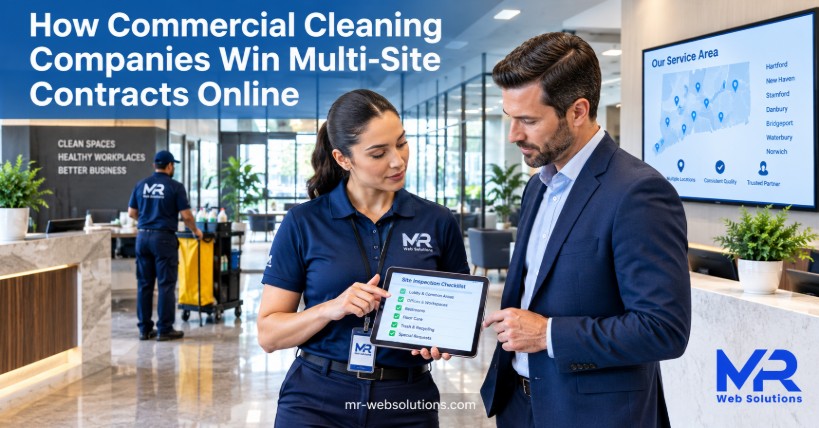
Commercial cleaning companies win multi site contracts online by making the buyer's vetting easy. That means a website that proves coverage for every location, a compliance page with insurance, bonding and safety documents, real portfolio case studies, a capability statement, active monitoring of RFP portals like CTsource, and steady follow up until renewal.
A website will not win the contract by itself. It gets you shortlisted, and it makes the buyer's checks easy. Your crew and supervisors keep the account.
How do facility managers and procurement teams find and vet a cleaning company?
Start with the buyer. Everything on your website should answer their questions before they ask.
Who actually buys multi site cleaning?
Portfolio contracts usually come from:
- Facility managers running office portfolios
- Procurement teams at hospital and medical groups
- Regional managers for retail stores and bank branches
- Property management firms with several buildings
In Hartford, that means insurance campuses, hospital systems and their outpatient clinics, and state offices in the Capitol region. Each one buys differently, but all of them check you before they call.
Where do they look first: Google, LinkedIn or a bid portal?
Usually all three, at different stages.
- Google builds the shortlist. A search like "commercial cleaning company Hartford CT" shows who is local and established.
- LinkedIn checks the people. Buyers want to see who runs the company and who would supervise their sites.
- Bid portals carry public and institutional work, like state agencies and towns.
If you are missing from one of these, you may never know a contract existed.
What do they check before they ever call you?
Two buyer side sources line up well here. KBS, a national janitorial provider, lists what multi site buyers look for. AZ Big Media's vetting checklist adds what procurement teams ask contractors to prove.
Together, the common checks are:
- Consistent standards across every site
- Real local presence, not loose subcontractors
- Pricing tied to scope, often broken down by zone
- References from similar portfolios
- A named site supervisor and how often they inspect
- Staffing continuity, so the same people show up
- Reporting on attendance, inspections and service verification
- A certificate of insurance with the buyer as additional insured
- Fidelity bonding against theft
- A site walk before pricing
- A cure period in the contract, often around 30 days, to fix problems before termination
Staffing worries are real. The Bureau of Labor Statistics projects about 321,800 openings a year for janitors and building cleaners. Buyers know turnover is high, so they look for proof yours is managed.
Why does a regional company still have a real chance?
Many owners worry they are too small to compete with national franchises. We understand the fear, but it is not the full picture.
KBS itself lists real local presence as something buyers want, instead of a national brand that subcontracts the work. A regional company with local supervisors, fast response and clear reporting can be exactly what a Hartford buyer is looking for.
The job is to prove that online, before the first meeting.

What must your website show to win multi site commercial cleaning contracts?
Most cleaning websites are built for homeowners. "We clean homes and offices," a quote form, a few photos. A procurement team needs something different. Here is what our commercial cleaning website design work focuses on.
Does your site prove you can cover every location?
A buyer with eight sites wants to know, fast, if you can handle all eight. Show it:
- A service area coverage map, embedded or as a simple region graphic
- A list of towns you serve
- Response times by region, if you can commit to them
If a buyer has to email you to find out where you work, many will not bother.
Do you need a separate page for each city or district you serve?
Yes, when each page is genuinely useful. A copied page with the town name swapped helps nobody.
For Premier Contract Cleaning, we built a topical map and wrote location pages for Dublin business districts. Sandyford and Leopardstown, Dublin 2 and the Docklands, Dublin 1, Dublin 4 and Ballsbridge each got its own page. The aim was not just ranking. Each page answers what buyers in that district care about: the types of buildings there and how the work gets done.
Pro Alliance Cleaning in South Florida is a second example. It serves several neighboring cities, with separate pages for places like Fort Lauderdale and Pembroke Pines. The challenge there is handling more than one city on one website without the same page appearing twice under different names.
You can see more cleaning websites we have built on our projects page.
What makes a location page useful instead of thin?
- [ ] Local building types (office parks, medical suites, retail)
- [ ] A named supervisor or team lead for that area
- [ ] Service hours, including after hours access
- [ ] A local project or photo, with permission
- [ ] Local reviews
- [ ] A link to your compliance page
How should you show supervision, quality control and reporting?
Buyers ask for reporting on attendance, inspections and service verification, as KBS notes. So show your quality assurance system on the site:
- How often supervisors inspect each site
- How inspection scores work
- How issues are logged and fixed
- What the client sees: reports, photos, attendance records
Even a simple page with a sample inspection report tells a buyer you run a tight operation.
How do you make it easy for a buyer to request a site walk or send an RFP?
Give commercial buyers their own path. A "Commercial and RFP enquiries" form should ask for:
- Number of sites
- Approximate square footage
- Cleaning frequency
- Desired start date
Keep it separate from any residential quote form. That way your CRM can tag it as commercial right away. We explain why in our post on residential and commercial funnels.
If you want a second pair of eyes, we will check your site against the buyer checklist in this article for free. Ask for a free growth audit.
Which compliance proof do multi site buyers expect to see?
Compliance is where many regional companies look smaller than they are. The documents exist. They are just not visible.
What insurance and bonding should your site and bid package show?
Swept, a janitorial software company, lists the common coverage buyers expect:
- General liability, often $2 million or more
- Workers compensation
- Commercial auto
- Bonding, which may be required for large contracts
Many buyers also ask to be named as additional insured on your COI (certificate of insurance). A janitorial or fidelity bond covers theft risk, which matters when your staff work unsupervised after hours.
Treat these as common requests, not fixed rules. Every RFP states its own limits, so follow the numbers in the bid.
What OSHA training matters for medical and healthcare sites?
If you clean clinics or hospital buildings, the OSHA Bloodborne Pathogens standard (29 CFR 1910.1030) applies to employees with exposure. It requires:
- A written exposure control plan, reviewed and updated at least once a year
- The Hepatitis B vaccine offered within 10 working days of assignment, at no cost to the employee
- Training at least once a year
Medical groups in Hartford will expect this program to exist before they let your crew into an exam room. A short summary on your site, and the full plan in your bid folder, shows you are ready.
Are Green Seal GS 42 and ISSA CIMS worth it?
Both are real, respected standards. Here is what they ask for.
Green Seal GS 42 (Edition 2.3) covers in house and contracted cleaning of commercial, public and industrial buildings. It requires:
- A written cleaning plan for each building
- Only environmentally preferable cleaning products
- 12 hours of training at hire, 12 more in the first year, then 24 hours every year
ISSA CIMS, the Cleaning Industry Management Standard, is a management standard for building service contractors and in house cleaning teams. There is also a CIMS Green Building certification.
Our honest view: these matter most for green building, government and large institutional buyers. For a 10 person company, they are rarely the first thing to spend on. Insurance, bonding and safety documents come first, because every buyer checks those.
Where should these documents live on your website?
On one "Compliance and Safety" page:
- How to request your COI
- Bonding details
- Certifications, with links to the certifier
- A short safety training summary
Then link to it from every location page. A buyer should never have to hunt for it.
What is a capability statement and do cleaning companies need one?
A capability statement is a one page summary of your company for buyers. It is common in government contracting, and more private buyers now ask for one.
What goes on a cleaning company capability statement?
Keep it to one page:
- Company summary: who you are, how long you have operated
- Core services: office, medical, retail, floor care
- Service area: your coverage map in small form
- Certifications and insurance
- Past performance: portfolio clients, with their permission
- Differentiators: supervision structure, reporting, response times
- Business identifiers: such as your NAICS code and registration details
- Contact details for commercial enquiries
Where do you use it?
- A download on your website
- The Featured section of your LinkedIn page
- A follow up email after a site walk
- An attachment to RFP responses and supplier registrations
How do you find multi site cleaning RFPs in Connecticut?
An RFP is a request for proposal. Public RFPs are posted online, and many cleaning companies simply never look.
How does CTsource work for janitorial bids?
CTsource is the State of Connecticut's contracting portal. It has:
- A Bid Board for open solicitations
- A Contract Board for active contracts
- Open viewing, with no registration needed to browse
- Registration required to respond to a bid
- Custom email alerts for the kinds of bids you want
Reading one scope of work a week teaches you a lot about what buyers ask for. It also shows you which contracts are active and when they might come up again. If you also do exterior work, our guide on commercial pressure washing contracts in Connecticut covers that side.
Should you get Connecticut SBE or MBE certification?
The state's Department of Administrative Services runs a Supplier Diversity program that certifies small business enterprises (SBE) and minority business enterprises (MBE).
To be eligible, a business must be based in Connecticut, independent, and registered in SAM, the federal System for Award Management. State agencies set yearly spending goals with certified companies. For a regional cleaner going after state work, it can be worth a look.
What changes when you bid on a state service contract?
State service contracts can come with wage rules. Under Connecticut's standard wage law for certain state service contracts, as summarized in Eastern Connecticut State University's procurement manual, covered service workers must be paid set standard wages.
Which contracts are covered depends on the details. So read the wage section of every state bid before you price it, and check with the Connecticut Department of Labor if anything is unclear.
What about private RFPs from hospitals, insurers and property managers?
Many private portfolio bids are invitation only. You will not find them on a portal.
You get invited by being findable and already known. A strong website, an active LinkedIn presence and a past site walk all put your name on the list when the buyer sends invitations.
How do Google Search and Google Ads bring in commercial cleaning contracts?
Search is still where most shortlists start. Our local SEO in Hartford work for commercial cleaners focuses on the searches buyers actually make.
Which searches do facility managers actually type?
Usually simple, local phrases:
- "commercial cleaning company Hartford CT"
- "janitorial services Hartford"
- "office cleaning West Hartford"
- "medical office cleaning Connecticut"
Your location pages and service pages should match these phrases naturally. Buyers also see AI answers now, which we cover in our post on AI Overviews in Connecticut search.
Does your Google Business Profile matter for commercial work?
Yes, for the shortlist. A buyer searching locally often sees the map results first.
The rule is simple: one Google Business Profile for each real, staffed office. Never fake addresses to appear in more towns. Google removes them, and buyers notice.
We see how Hartford County search works through clients like Mr-Suds, a pressure washing company in Newington, where map results shift sharply from one town to the next. A consistent brand across your profile, website and directories helps Google understand who you are. Our post on entity SEO goes deeper.
How do you run Google Ads for commercial terms only?
Commercial cleaning ads waste money fast if homeowners click them. A tight setup:
- Commercial keyword themes: office cleaning, janitorial services, medical office cleaning
- Negative keywords: house, home, apartment, move out, maid
- A landing page per buyer type: medical, offices, retail
- Call tracking, so you know which ads bring real enquiries
What does it cost? LocaliQ's 2026 search advertising benchmarks for Business Services show:
| Metric | Business Services average, 2026 |
|---|---|
| Cost per click | $5.87 |
| Click through rate | 6.10% |
| Conversion rate | 4.85% |
| Cost per lead | $93.69 |
One multi site contract is worth far more than a single lead, so a commercial cost per lead in this range can make sense. Only if the follow up is there.
Can LinkedIn really help you win facility management accounts?
Yes, when your profile and website back up the outreach. LinkedIn is where facility managers, operations directors and procurement managers spend their working hours.
What should your company page and owner profile show?
- Your coverage area
- Certifications and insurance
- Real photos of crews and supervisors
- Short project updates, with client permission
- Your capability statement in the Featured section
When a buyer looks you up after a cold email, this is what they find.
How do you reach out without sounding like spam?
Slowly and helpfully:
- Connect with the facility manager.
- Comment on their posts with something useful.
- Send a short note tied to their region or building type.
- Offer a free site walk, with no pressure.
Skip the long sales pitch. A buyer who sees a helpful, local company several times is more likely to reply when their contract comes up.
How do you follow up on a multi site account until the contract is up?
This is where many cleaning companies lose deals they could have won. Not to a competitor. To time.
Why do multi site deals take so long?
Several reasons:
- The buyer already has a vendor under contract.
- Budgets run on yearly cycles.
- Decisions go through committees.
A buyer can like you and still wait months for their renewal date. If you stop following up, someone else is there when the date arrives.
What does an account based follow up plan look like?
In the GoHighLevel CRM we set up for clients, a commercial pipeline might use these stages:
| Stage | What happens |
|---|---|
| Identified | Account added, sites and decision maker noted |
| Contacted | First email, call or LinkedIn note |
| Site walk | Walkthrough booked or completed |
| Proposal | Bid or proposal sent |
| Waiting for renewal | Buyer interested, current contract still running |
| Won or lost | Outcome recorded, with the reason |
Tag every account with its number of sites and its contract end date. Then plan a useful touch every quarter: a seasonal floor care note, a compliance update, a short case study. Each one keeps your name in front of the buyer without being pushy.
What happens when a facility manager calls and nobody answers?
Facility managers call during business hours. That is also when you are on a floor machine or walking a site.
If the call goes to voicemail, they may call the next company on the list. An AI receptionist for missed calls answers, asks how many sites and when they want to start, and books the site walk. Our Scale plan supports multiple locations.
Practical example: what a Hartford cleaning company's online setup should look like
This is an illustrative setup, built from the approach we used for Premier Contract Cleaning and Pro Alliance Cleaning. It is not a client result.
The Hartford buyer map
Hartford has a dense mix of portfolio buyers:
- Insurance campuses downtown and in the suburbs
- Hospital systems such as Hartford HealthCare and Trinity Health Of New England, plus their outpatient clinics
- Connecticut Children's
- State offices around the Capitol
- Office parks in Windsor, Bloomfield, Farmington, Glastonbury and Rocky Hill
Each group checks vendors differently. Medical buyers look hard at OSHA readiness. State offices go through CTsource. Insurance campuses often want strong references and reporting.
How we would structure the site
For a regional cleaner going after these buyers, we would build:
- A coverage map for Hartford County
- Location pages for Hartford, West Hartford, East Hartford, Glastonbury, Farmington, Windsor and New Britain
- Industry pages for medical offices and corporate offices
- A Compliance and Safety page with insurance, bonding and OSHA details
- A capability statement to download
- A commercial RFP form, tagged straight into a commercial pipeline in the CRM
It is the same idea as the Premier district pages. Each location page speaks to the buildings and buyers in that town: medical offices in Farmington, office parks in Windsor, municipal and state buildings in Hartford. A facility manager with sites in four of those towns can see your coverage in a few clicks.
Checklist: are you ready for a multi site RFP?
| Item | Where it lives | Ready? |
|---|---|---|
| Certificate of insurance and bonding proof | Compliance page and bid folder | Yes or No |
| Service area coverage map | Website | Yes or No |
| Location pages for each served area | Website | Yes or No |
| QA and inspection reporting sample | Website and bid folder | Yes or No |
| OSHA bloodborne pathogens program (medical sites) | Bid folder | Yes or No |
| Certifications (GS 42, CIMS) if pursued | Compliance page | Yes or No |
| Capability statement | Website, LinkedIn, email | Yes or No |
| Portfolio case study | Website | Yes or No |
| CTsource registration and alerts | Portal | Yes or No |
| Commercial pipeline in CRM | CRM | Yes or No |
If you answered "No" to three or more, start with the compliance page and coverage map. Those two fix the most common reasons buyers move on.
Frequently asked questions
How do small cleaning companies get commercial contracts?
Start with single sites near you and do excellent work. Document the results, with client permission, as case studies. Then approach portfolio buyers with proof: a coverage map, a compliance page, references from similar buildings and a capability statement. Buyers often prefer a regional company with local supervision.
Where are cleaning RFPs posted in Connecticut?
State agency bids are posted on CTsource, the State of Connecticut contracting portal, where you can browse the Bid Board and set email alerts. Towns and cities post bids on their own purchasing pages. Many private hospital, insurer and property management bids are invitation only.
Do I need to be bonded for commercial cleaning contracts?
Not in every case, but many buyers ask for it. A janitorial or fidelity bond protects the client against theft, which matters when your staff work after hours without supervision. Large contracts often require bonding, so check each RFP's requirements before you bid.
How much insurance do commercial cleaning companies need?
General liability, workers compensation and commercial auto are the standard set. Swept notes general liability of $2 million or more is common. Limits vary by contract, and many buyers ask to be named as additional insured, so always follow the limits stated in each RFP.
Is GS 42 certification worth it?
It can be, for green building, institutional and government work. Green Seal GS 42 requires a written cleaning plan for each building, environmentally preferable products and set training hours every year. For a smaller company, insurance, bonding and safety documents usually come first.
What is a capability statement for a cleaning business?
It is a one page summary for buyers. It covers your services, service area, insurance and certifications, past performance, what makes you different, and how to contact you. Use it on your website, on LinkedIn, after site walks and with RFP responses.
Should I create a page for every city I serve?
Yes, if each page has real local detail: building types in that area, the supervisor who covers it, service hours and local projects or reviews. Avoid copied pages with only the town name changed. Those help neither buyers nor search.
Do Google Ads work for commercial cleaning?
Yes, when you limit them to commercial searches and block residential ones with negative keywords like house, home and maid. LocaliQ's 2026 benchmarks for Business Services show an average cost per lead of $93.69, which can make sense when one contract covers several sites.
How long does it take to win a multi site contract?
Often months. Many buyers already have a vendor under contract and wait for the renewal date before switching. Budget cycles and committee decisions add time. Keep each account in your CRM with its contract end date and stay in touch until then.
Does LinkedIn work for cleaning companies?
Yes, for reaching facility managers, operations directors and procurement managers. It works best when your company page and owner profile show coverage, certifications and real crew photos, and your website backs it up. Helpful, steady contact beats a long cold pitch.
Want your website ready for portfolio buyers?
Our founder, Shohanur Reza, puts it plainly when we talk to cleaning owners: the website gets you shortlisted, and your team keeps the contract. We focus on the first part, so your crews get the chance to prove the second.
If you want to know where your site stands, we will check it against the buyer checklist in this guide. Get a free growth audit or book a call. If facility manager calls are slipping through while you are on site, try the AI receptionist free for 14 days.
You can also read what our clients say and see the industries we work with.
Call +1 (860) 255 1070, or visit us at 375 Wethersfield Ave, Hartford, CT 06114.