By the MR Web Solutions team, Hartford, CT
While working on the Bridge Bright Cleaners website, we kept looking at one page: the service list. On one side sat weekly and one time house cleaning. On the other sat offices, daycares, religious buildings, retail spaces and apartment common areas. It read like two different businesses sharing one roof.
That is the problem with most cleaning company Google Ads accounts we see. A homeowner searching "biweekly house cleaning" on a Saturday morning and an office manager searching "janitorial service quote" on a Tuesday are not the same buyer. They will not click the same ad, and they should never land on the same page.
This article walks through how we approach Google Ads for cleaning businesses, with Hartford and Connecticut as our home market. It covers how we split residential and commercial campaigns, which keywords and match types we use today, the negative keyword list we start every cleaning account with, what budgets look like against 2025 benchmarks, whether Local Services Ads fit, and how calls and forms get tracked into a CRM.
What is the short answer on cleaning company Google Ads?
Cleaning company Google Ads work best as two separate Search campaigns: one for residential house cleaning and one for commercial or janitorial work. Use phrase and exact match, block job, salary, supply and DIY searches with negative keywords, target only towns you serve, track calls and forms, and start around $1,000 to $1,500 a month.
That starting range is a recommendation, not a promise. It comes from the budget math further down, where a 2025 cleaning benchmark of about $47 per lead puts that spend at roughly 20 to 30 leads a month.
Why should house cleaning and commercial cleaning run as separate campaigns?
Back to the Bridge Bright service list. The services were all real, and the company does all of them well. The issue is that each side attracts a different person, with a different budget, at a different time of day.
Put them in one campaign and Google treats them as one audience. It does not know that a $9 click from someone wanting a one time apartment clean is a poor fit for a page about janitorial contracts. It just sees a click.
We cover the same idea for exterior cleaning in our post on residential and commercial funnels. For cleaning companies, the split matters even more, because the gap between a $176 house clean and a yearlong office contract is huge.
How do residential and commercial buyers search differently?
Homeowners usually search in the evening or on weekends, mostly on their phones. They care about price, trust and timing. Their searches sound like "house cleaners near me," "biweekly cleaning" or "move out cleaning West Hartford."
Office managers and property managers search on weekdays, often from a desk. They want a company, not a person. Their searches include words like "quote," "contract," "janitorial service" or "office cleaning company." The sales cycle is longer, and there is usually a walkthrough before any price.
What goes wrong when both share one campaign?
Three things, usually all at once.
First, the budget gets eaten by residential searches, which are cheaper and more common. Commercial ads barely show. Second, one landing page has to speak to both buyers, so it speaks to neither. Third, if you use Smart Bidding, Google learns from the wrong conversions and keeps chasing the easier, lower value lead.
Residential vs commercial campaign blueprint
Here is how we set the two campaigns side by side.
| Setting | Residential house cleaning | Commercial and janitorial |
|---|---|---|
| Example keywords | house cleaning service, biweekly house cleaning, move out cleaning | janitorial services, office cleaning company, commercial cleaning quote |
| Match types | Phrase and exact | Phrase and exact |
| Location | Town list of the towns you serve | Wider county area plus nearby business corridors |
| Ad schedule | When someone answers, or 24/7 with call coverage | Weekday business hours |
| Landing page | Services, towns, recurring options, short form | Industries served, walkthrough request, longer form |
| Conversion goal | Booked cleaning | Walkthrough booked |
| Follow up speed | Minutes | Same business day |
| Local Services Ads fit | Yes, house cleaning is an eligible category | No, janitorial is not a listed category |
| Typical sales cycle | Days | Weeks or months |
The rest of this article builds out each row.
Which keywords should a cleaning company bid on?
Keep ad groups tight. One service per ad group, with ads and a page that talk about that one service. When a search for "move out cleaning" shows an ad that says "Move out cleaning in Wethersfield," people click, and Google rewards the match.
What are the best residential cleaning keyword themes?
These are the ad group themes we start with for a residential campaign:
- House cleaning: house cleaning service, house cleaners near me, house cleaning Hartford CT
- Maid service: maid service, maid service near me
- Recurring cleaning: weekly house cleaning, biweekly house cleaning, recurring cleaning service
- Deep cleaning: deep cleaning service, deep house cleaning
- Move out and move in: move out cleaning, move in cleaning, end of lease cleaning
- Airbnb turnover: Airbnb cleaning, vacation rental turnover cleaning
- Apartment cleaning: apartment cleaning service
Then add town modifiers for the places you actually serve. Around Hartford, that might mean West Hartford, Glastonbury, Wethersfield, Newington, Manchester, Simsbury, Avon and Farmington. "Deep cleaning Glastonbury" is a smaller search than "deep cleaning," but the person typing it is usually ready to book.
What are the best commercial and janitorial keyword themes?
The Bridge Bright commercial list makes a good template here, because it mirrors who actually buys commercial cleaning:
- Office cleaning service
- Janitorial services
- Commercial cleaning company
- Medical office cleaning
- Daycare cleaning
- Church cleaning
- Post construction cleaning
- Floor stripping and waxing
- Apartment common area cleaning
Add buyer words to these: "quote," "contract," "company" and "services." A search for "janitorial services quote" is a different person from a search for "janitorial," which often belongs to someone looking for a job.
Which "cleaning" keywords look good but waste money?
Some keywords look perfect and quietly drain the budget:
- "Cleaning" on its own. Too broad. It could mean anything from teeth to gutters.
- "Cleaners." For many people, this means dry cleaners. More on that in the negatives section.
- "Carpet cleaning" or "window cleaning" if you do not offer them.
- "Cleaning services near me." It is mixed intent. One agency, Abstrakt, says in its experience most of these searchers are homeowners, not business buyers. That is their view, not a published study, but it matches what the words suggest. Keep this term in a residential campaign, not a commercial one.
Which match types work for cleaning ads today?
A lot of older guides still talk about "broad match modifier." Google retired that years ago. Today there are three match types, and Google's help page on keyword matching options explains how each one behaves now.
How do broad, phrase and exact match behave now?
- Broad match shows your ad on searches related to your keyword, even ones that do not include its words. Google says it is critical to use Smart Bidding with broad match.
- Phrase match shows your ad on searches that include the meaning of your keyword.
- Exact match shows your ad on searches with the same meaning or intent as your keyword.
Notice the word "meaning." Even exact match is not exact anymore. A keyword like [house cleaning] can match "home cleaning service." That is usually fine, but it is also why negative keywords still matter on every match type.
Should a small cleaning company use broad match?
Not at the start, in our view.
Broad match leans on Smart Bidding, and Smart Bidding needs conversion data to make good choices. A new cleaning account has very little. Turn on broad match on day one, and Google will happily test "cleaning jobs," "cleaning supplies" and "how to clean an oven" with your money.
We start with phrase and exact while the data builds. Later, we may test broad in one ad group, with a strong negative list and Smart Bidding in place, and compare.
What does AI Max for Search change?
AI Max is a newer Google Ads setting, and owners often do not realize it is on. According to Google's AI Max help page, it turns on search term matching for the campaign by default. That lets ads show on searches beyond your keywords, using broad match and methods based on your assets and landing pages.
Google also notes you can toggle it off in the ad group settings. If your search terms report suddenly fills with odd searches, check this setting first.
If you want a second pair of eyes on your current keywords and search terms, ask us to review your cleaning ads. We look at the account and the landing page together.
What negative keywords should every cleaning company add?
This is the most important section of the article. In our experience, the biggest leak in cleaning accounts is not the bid or the ad copy. It is the searches nobody blocked.
Why do job seekers eat so much of a cleaning ad budget?
Because there are so many of them. The Bureau of Labor Statistics counts about 2.4 million janitor and building cleaner jobs in 2025, with a median pay of $36,840 and about 321,800 openings projected each year.
That is a huge pool of people typing "cleaning jobs near me," "house cleaner hiring" and "janitor pay." To Google, "house cleaner" from a job seeker and "house cleaner" from a homeowner look very similar. Without negatives, you pay for both. That evening call from someone asking if you are hiring is often a paid click.
The cleaning negative keyword list we start with
Working on Boca Best Cleaners' Google Business Profiles taught us one lesson that sits in this list. Boca Best is a dry cleaner in Boca Raton, and to a lot of searchers, "cleaners near me" means dry cleaning. For a house cleaning company, that is a click you never wanted. So "dry cleaning" and its cousins go in from day one.
Here is the list, grouped so you can copy it. Remove anything you actually offer.
Jobs and hiring
- jobs, job, hiring, hire me, employment, career, careers, apply, application, resume, salary, salaries, wage, wages, pay rate, per hour pay, indeed, glassdoor, ziprecruiter, craigslist, part time, full time, now hiring, openings, interview
Training and starting a business
- training, course, certification, certified, class, school, license, how to start, start a cleaning business, franchise, business plan, insurance for cleaning business, bonded and insured cost, software, app
DIY and informational
- how to, how do i, diy, yourself, tips, hacks, checklist, guide, tutorial, video, youtube, reddit, home remedy, recipe
Supplies, products and chemicals
- supplies, supply, products, product, chemicals, chemical, bleach, vinegar, spray, solution, detergent, wipes, mop, vacuum, vacuums, equipment, machine, rental, wholesale, amazon, walmart, home depot, lowes, costco
Free and bargain hunters
- free, cheap labor, volunteer, donation, grant, coupon code
- Use these with care. If you run promotions, do not block words like "deals."
The wrong kind of "cleaning"
- dry cleaning, dry cleaners, laundry, laundromat, alterations, tailor, car wash, car detailing, auto detailing, pool cleaning, gutter cleaning, chimney cleaning, duct cleaning, dryer vent, teeth cleaning, dental cleaning, ear cleaning, pressure washing, power washing, septic, carpet cleaning, upholstery, window cleaning
Residential campaign only (blocks commercial searches)
- commercial, janitorial, office, warehouse, industrial, contract, bid, rfp, government
Commercial campaign only (blocks residential searches)
- house, home, maid, apartment, airbnb, move out, residential
Research and lookups
- definition, meaning, salary of, average, statistics, synonym, near me jobs
One caution on "apartment" in the commercial list. If you clean apartment common areas for property managers, use a more specific negative like "apartment cleaning service" instead.
Do negative keywords catch plurals and close variants?
No, and this trips up a lot of owners. Google's help page on negative keywords states that negative keywords will not match close variants or other expansions. You need to add synonyms and singular or plural versions yourself.
That is why the list above has both "job" and "jobs," "chemical" and "chemicals," "vacuum" and "vacuums." Your positive keywords stretch to cover variations. Your negatives do not.
Where should negative lists live, and how often do we review them?
We split them into two levels.
- Account level shared lists for the groups that apply everywhere: jobs, training, DIY, supplies and the wrong kinds of cleaning.
- Campaign level negatives for the cross blocking between residential and commercial.
Then we read the search terms report weekly for the first month, and every two weeks after that. New junk always shows up. The list is never finished.
A Hartford area example
Here is a typical scenario, not a client account. A Wethersfield house cleaning company opens its search terms report and finds "cleaning jobs West Hartford" and "dry cleaners Newington."
"Cleaning jobs West Hartford" is covered by the jobs group, so "jobs" goes into the shared account list. "Dry cleaners Newington" belongs to the wrong kind of cleaning group, so "dry cleaners" goes in there. Two searches, two lists, and neither one costs the company again.
How much should a cleaning company spend on Google Ads?
Every competitor guide gives a range. Few show where it comes from. Here is ours, with sources.
What do cleaning clicks and leads cost in 2025 and 2026?
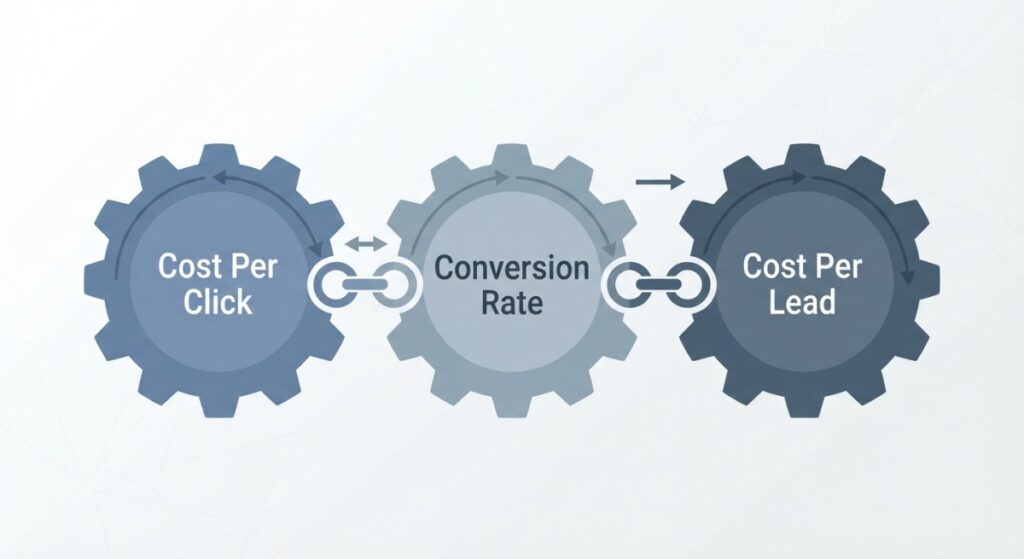
WordStream by LocaliQ's 2025 home services benchmarks, as summarized by Web Tonic, put the cleaning, maid and butler services category at:
- Click through rate: 9.01 percent
- Conversion rate: 17.65 percent
- Cost per lead: about $46.99, against $90.92 for home services overall
That summary does not publish a cleaning specific cost per click. For context, the home services average cost per click is about $7.85.
Across all industries, the same benchmark data puts the 2025 average cost per click at $5.42 and the average cost per lead at $70.11, per Search Engine Land.
Commercial cleaning clicks tend to cost more. Abstrakt reports $8 to $15 per click in most metros from its own work. That is one agency's experience, not a study.
For the step from cost per lead to cost per booked job, see how we calculate cost per booked job.
What is a cleaning lead worth?
A lot more than one clean, if it turns recurring.
Angi's 2026 data puts the average house cleaning visit at $176, with most people paying $118 to $238. Biweekly cleaning runs about $200 to $500 a month.
Here is the simple math. One biweekly client at $300 a month, kept for six months, is $1,800 in revenue. That is arithmetic, not a client result, but it shows why a $47 lead is not expensive if a fair share of leads become recurring clients.
What starter budget makes sense?
For a residential campaign, we suggest starting around $1,000 to $1,500 a month.
At the $46.99 benchmark cost per lead, $1,000 divided by $46.99 is about 21 leads, and $1,500 divided by $46.99 is about 32. That is enough volume to learn which towns, services and times convert.
For commercial, start with a smaller, separate budget. Volume is lower and clicks cost more, so the goal at first is learning which commercial searches show real buying intent.
Remember that Google sets a daily budget, not a monthly one. Its ad scheduling help page notes that campaigns pace toward a monthly spend of 30.4 times the average daily budget. So $1,200 a month is about $39.50 a day.
Other guides suggest anything from a $500 to $1,000 test up to $5,000 a month. Ours is a starting point, not a guarantee. For where Google Ads sits in your total spend, see our total marketing budget benchmarks.
Which bid strategy should you start with?
We usually start with Maximize Clicks with a cost per click cap, or Manual CPC, until tracking proves it works. Once conversions come in reliably, we move to Maximize Conversions. When there is a steady flow, Target CPA becomes an option.
A common guideline among practitioners is to wait for roughly 15 to 30 conversions before switching to a conversion based strategy. Treat that as a rule of thumb, not a Google rule.
Can a house cleaning company in Connecticut use Local Services Ads?
Often, yes. Local Services Ads (LSA) are the pay per lead ads that show at the very top of some searches, with a badge and reviews.
Is house cleaning an eligible LSA category?
Yes. Google lists "House cleaning services" among eligible categories on its Local Services Ads getting started page. Google's Actions Center also lists House Cleaner under Home Services.
Availability still depends on location, so use Google's "Check eligibility" tool with your ZIP code, such as 06114 for Hartford, to confirm for your town.
Janitorial and commercial cleaning are not named as categories on either page. Commercial cleaning companies should plan on Search campaigns.
What does Google ask house cleaners for?
Google's page lists a license or business registration and its own onboarding checks. A 2024 guide from Widewail adds more detail: background checks on the owner and certain employees, insurance documents, and a minimum of five reviews for house cleaning. Requirements change, so confirm them in your own LSA account.
Google's current page describes the "Google Verified" badge, not the older "Google Guaranteed" name. It also mentions pre badge ads, which let some providers receive leads after preliminary checks while onboarding finishes.
Reviews are the part owners can start today. Our local SEO and Google Business Profile work helps build that base.
Should you run LSA and Search ads together?
For an eligible house cleaning company, usually yes. LSA is pay per lead and sits above Search ads. Search ads cover the services, towns and keywords LSA does not reach, like Airbnb turnover or a specific town name.
Commercial and janitorial companies rely on Search. For the step by step LSA process, see our LSA eligibility walkthrough.
How should you target Hartford and the towns you actually serve?
Pro Alliance Cleaning works across South Florida, with location pages for Fort Lauderdale and Pembroke Pines and a service area that runs from Miami up to West Palm Beach. One giant circle on the map would cover a lot of places the company does not want to drive to. A list of real towns is cleaner.
The same thinking applies around Hartford. Google's location targeting help page covers the options.
Radius or town list?
Google requires a radius of at least 1 km. A tiny radius can make ads show only now and then.
For residential, we prefer a town list. Around Hartford, that might be West Hartford, Wethersfield, Newington, Rocky Hill, Glastonbury, Manchester, Bloomfield, Windsor, Farmington, Avon and Simsbury. If a radius fits better, try around 15 miles from your base and check the map before saving.
For commercial, widen it. Hartford County, plus Middletown, Meriden and New Britain, covers the offices and medical buildings along Interstate 84, Interstate 91 and Route 9.
Presence or Presence or interest?
Google recommends "Presence or interest" as a best practice on Search. It also says "Presence" is the better fit when you only want people physically in your locations.
A cleaning crew drives to the house. Someone in another state reading about Hartford is not a customer. So we use Presence, and the budget stays with people who can actually book.
Practical example: a Hartford area residential plus commercial setup
Here is a hypothetical setup, not a client account:
- Residential: 11 Capitol region towns, Presence only, ads Monday to Saturday.
- Commercial: Hartford County plus the nearby business corridors, Presence only, weekdays only.
How do you track calls, forms and booked jobs from cleaning ads?
Without tracking, you are guessing. With it, you know which keyword produced a recurring client.
How do you count phone calls as conversions?
There are two kinds of calls to track. Calls straight from the ad, through call assets. And calls from your website, through a Google forwarding number that replaces your number on the page.
Google's call tracking help page explains that a call counts as a conversion when it lasts longer than a minimum length you set. That keeps wrong numbers and hang ups out. Many cleaning accounts use 60 to 90 seconds, which is a common setting rather than a Google rule.
How do form leads reach the CRM and back to Google Ads?
Here is the chain we build:
- Someone fills out the form on the landing page.
- The lead drops into a GoHighLevel pipeline.
- An instant SMS confirms we got the request.
- The text includes a booking calendar link.
- When a cleaning is scheduled, the lead moves to a "booked" stage.
That booked stage is the conversion that matters. A form fill is a start. A booked cleaning is the result.
We run this kind of pipeline in our own CRM every day. The Mr-Suds subaccount, a pressure washing client in Newington, holds over 470 contacts, each tied to a stage. If you are still choosing a CRM, read our comparison of GoHighLevel vs Jobber vs Housecall Pro.
What happens when nobody answers?
Homeowners often search for cleaning in the evening and on weekends. If nobody picks up, that click is gone, and you still paid for it.
Two fixes work. Run ads only when someone can answer. Or cover the phone around the clock. Our AI Receptionist answers 24/7, captures the caller's details, books the cleaning and logs everything to the CRM. Plans start at $79 a month, and you can try the AI Receptionist free for 14 days.
What should a cleaning ad landing page include?
The ad gets the click. The page gets the booking. Sending paid traffic to a generic homepage is one of the most common leaks we see.
One page per campaign
The residential page should list services, the towns you serve, recurring options, reviews, a short quote form and a tap to call button. If your staff is insured and background checked, say so clearly. Only if it is true.
The commercial page should list the industries you serve, offer a walkthrough, mention that an insurance certificate is available on request, and use a longer form that asks for square footage and cleaning frequency.
Bridge Bright's site shows why this matters. Its homepage form uses one services dropdown for every buyer. For ads, we would give each campaign its own page and its own form, so a daycare director never has to scroll past move out cleaning to ask for a walkthrough. We build landing pages built for cleaning companies this way.
Landing page checklist
- The headline matches the ad group
- The phone number is tracked
- The residential form has fewer than six fields
- The town names are visible on the page
- Real reviews are on the page
- The page loads fast on a phone
- A thank you page fires the conversion
When should cleaning ads run?
The best schedule is the one that matches who answers the phone.
Ad schedule by campaign
Residential: run ads when someone can answer, or 24/7 if an AI receptionist covers the calls. Once you have a few weeks of data, adjust bids for evenings and Saturday mornings if they convert well.
Commercial: weekday business hours. Office managers rarely shop for janitorial contracts at 9pm on a Sunday.
Use the Day and Hour report in Google Ads to see when calls and forms actually come in, then adjust.
Connecticut seasonality
Cleaning demand in Connecticut moves with the calendar. Spring cleaning picks up after long New England winters. Summer brings move outs and lease turnovers. November and December bring holiday guest cleans.
Plan budget increases for those windows. Set them in advance, rather than reacting after the calendar is already full or empty.
What have we learned building for cleaning companies?
Three client projects shaped how we think about cleaning ads.
Bridge Bright Cleaners showed us two buyers on one site. Residential and commercial need separate campaigns, pages and forms.
Pro Alliance Cleaning showed us how a long list of served towns works better than one big circle on a map.
Boca Best Cleaners showed us the "cleaners" confusion. To many searchers, cleaners means dry cleaning, and that word needs handling before any money is spent.
Now picture a Newington or Wethersfield cleaning company asking us to restart its Google Ads. Here is the order we would work in:
- Check that calls get answered, or set up call coverage first.
- Set up call and form tracking, with booked jobs as the main conversion.
- Split residential and commercial into separate campaigns.
- Add the shared negative lists before the first dollar is spent.
- Build one landing page per campaign.
- Target real towns with Presence only.
- Start on phrase and exact match with a modest budget.
- Check eligibility for Local Services Ads.
- Read the search terms report weekly and adjust.
Our rule is simple: we do not turn ads on until the phone gets answered and tracking works. Otherwise, you are paying for calls nobody hears and leads nobody can trace. You can see more of our work on our recent projects page and the home service industries we work with.
Cleaning company Google Ads FAQ
How much should a cleaning company spend on Google Ads?
We suggest starting around $1,000 to $1,500 a month for a residential campaign. At the 2025 cleaning benchmark of about $47 per lead from WordStream by LocaliQ, that is roughly 21 to 32 leads a month. Commercial campaigns should get a smaller, separate budget to start.
What is a good cost per lead for house cleaning?
The 2025 benchmark for cleaning and maid services is about $46.99 per lead, according to WordStream by LocaliQ data. Judge your own number against client value, though. One biweekly client at $200 to $500 a month can cover many leads over the months they stay with you.
What negative keywords should a cleaning business use?
Start with jobs and hiring terms, salary, training, DIY and how to searches, supplies and chemicals, "free," and the wrong kinds of cleaning, like dry cleaning, car detailing and teeth cleaning. Add singular and plural versions yourself, then review your search terms report weekly for the first month.
How do I stop job seekers from clicking my cleaning ads?
Add a shared account level negative list with jobs, hiring, salary, wage and job site names like Indeed. Use phrase and exact match instead of broad. Check whether AI Max is on, since it can expand matching. Then read the search terms report weekly and block new job searches as they appear.
Can house cleaners use Google Local Services Ads?
Yes. Google lists house cleaning services as an eligible category in the US. Expect license or business registration checks, and per industry guides, insurance documents, background checks and at least five reviews. Use Google's Check eligibility tool with your ZIP code to confirm your area.
Can janitorial companies use Local Services Ads?
Janitorial and commercial cleaning are not named as categories on Google's Local Services Ads pages. Commercial cleaning companies should plan on regular Search campaigns, with keywords built around office, medical, daycare and janitorial services, plus buyer words like "quote" and "contract."
Should I use broad match for my cleaning business?
Not at the start. Broad match depends on Smart Bidding, which needs conversion data a new account does not have yet. Start with phrase and exact match. Once conversions come in steadily, you can test broad match in one ad group with strong negatives and Smart Bidding.
How do I track calls from Google Ads?
Track calls from your ads with call assets, and calls from your website with a Google forwarding number that replaces your number on the page. Set a minimum call length so short calls and wrong numbers do not count as conversions. Many cleaning accounts use 60 to 90 seconds.
How long before cleaning ads bring steady leads?
First leads can arrive within days of launch. Steady, predictable results take longer, because bidding needs several weeks of conversion data and your negative list needs time to catch the junk searches. Judge the campaign after a few weeks of clean data, not after the first weekend.
Should residential and commercial cleaning have separate campaigns?
Yes. Homeowners and office managers search differently, at different times, with different budgets, and they need different landing pages. Separate campaigns let you set separate budgets, schedules and locations, and stop cheaper residential clicks from eating your commercial budget.
Want us to look at your cleaning ads?
If your ads bring more job seekers than customers, or you are not sure which keywords produce booked cleanings, we are happy to take a look. We will review your account, your negative keywords and your landing page, and talk it through with you. If the numbers do not make sense for your area, we will tell you.
Book a call with our team, or reach our Hartford office at +1 (860) 255 1070. And if after hours calls are slipping through, our AI Receptionist 14 day free trial is an easy way to test call coverage.