
By the MR Web Solutions team, Hartford, CT. Last reviewed October 2026: every rule below was checked against Connecticut Department of Consumer Protection pages and the Connecticut General Statutes.
We are in a website review for Mr-Suds Washing, the pressure and soft washing company we work with in Newington and Hartford. The trust line on the homepage reads "Licensed, Bonded and Insured!" It sits right above the list of towns the company serves. It is a good line.
Then we ask the question we now ask every Connecticut client. If a homeowner in Wethersfield wanted to check that claim in 30 seconds, could they? Licensed by whom? Under what number? Where would they look it up?
That question is the heart of Connecticut contractor licensing as it touches your marketing. Connecticut does not have one universal "contractor license." It has a Home Improvement Contractor registration, a New Home Construction Contractor registration, and exam based occupational licenses for trades like plumbing and electrical. Each one changes what a homeowner can verify, and what you should show online.
Most home service websites we see, including some we built ourselves, can do a better job of turning those rules into visible trust.
A quick note before we start: MR Web Solutions is a marketing agency, not a law firm. This article is general information, not legal advice. Rules change, so confirm your situation with the Connecticut Department of Consumer Protection at DCP.HomeImprovement@ct.gov or (860) 713 6000 before relying on it.
The short answer: what Connecticut contractor licensing means for your website
Connecticut requires most residential home improvement contractors to register with the Department of Consumer Protection, while plumbing, electrical, HVAC and other trades need occupational licenses. State law requires the registration number in any advertisement. On your website, show the number, credential type and insurance in the footer, contact page, service pages and quote forms.
The rest of this article explains which credential you likely hold, what the law says about advertising it, and exactly where it belongs on your site, your Google profile and your ads.
Which Connecticut license or registration does your business actually need?
This is where most owners get stuck. The words "license" and "registration" get used as if they mean the same thing. In Connecticut, they do not.
What counts as "home improvement" in Connecticut?
The Department of Consumer Protection (DCP) keeps a plain list on its home improvement knowledge base page. Home improvement is work that makes a permanent change to residential property, including:
- Driveways, swimming pools, porches, garages and patios
- Roofs, siding, insulation, flooring, doors and windows
- Landscaping, painting, fences and waterproofing
- Alarm systems that do not require electrical work
DCP also lists what does not count:
- Work homeowners do on their own property
- Subcontracted work
- Work covered by a trade license
- Work on commercial property
- Contracts under $200
- Routine property maintenance, such as snowplowing, mowing, pruning or cleaning
- Tree and shrub cutting and grinding
- Building new homes
There is one more threshold in the statute itself. Under Chapter 400 of the Connecticut General Statutes, section 20-419, a single job only counts as home improvement if it is over $200. The same section also excludes anyone whose home improvement contracts total $1,000 or less in any 12 months. For a working business, that second number is rarely a way out.
Who needs a Home Improvement Contractor (HIC) registration?
In short, anyone contracting with homeowners for home improvement work over $200 on residential property, unless an exemption applies.
The details, from DCP's HIC application page and the statute:
- Fee: a $220 non refundable application fee. The statute splits this into a $120 registration fee and a $100 yearly Guaranty Fund fee.
- Insurance: general liability coverage of at least $20,000. The application asks for the insurer's name and policy number.
- Legal entity: register as the same entity you contract under. If you sign contracts as an LLC, an individual registration does not cover the LLC. LLCs and corporations register with the Secretary of the State first.
- Expiry: every registration expires on March 31 each year.
Note that this is a registration, not a licensing exam. That matters for how you describe it online, which we cover below.
When do you need a New Home Construction Contractor registration instead?
If you build new homes, or portions of new homes, you need a New Home Construction Contractor registration. The total is $360: a $240 registration fee plus a $120 guaranty fund fee. It also requires $20,000 in general liability insurance and expires each March 31.
If you build new homes and also do home improvement work, adding home improvement authorization costs $100.
Which trades need a Connecticut occupational license?
Some work needs a true occupational license, not just a registration. DCP's occupational trades page lists nine trades:
- Electrical
- Elevator
- Fire protection
- Glaziers (automotive and flat glass work)
- Heating and cooling
- Home inspection
- Plumbing and pipefitting
- Sheet metal work
- Swimming pool and spa
These licenses work differently from HIC registration. They usually involve proving training and experience and passing a trade exam, and they come at different levels, such as journeyperson and contractor. DCP also points owners to a separate page about other licenses a contractor may need.
Here is the key exemption. Under section 20-428, someone with a current occupational license who works only within that license falls outside the Home Improvement Act.
Two logos on our own homepage show the difference. A contracting company like CW Contracting CT would typically show an HIC registration. A plumbing company like CT Premier Plumbing would typically show a state plumbing license. Same state, same homeowners, two very different credentials to display.
Do pressure washing, painting and cleaning companies need to register?
Painting is clear. It is on DCP's list of home improvement work, so residential painting jobs over $200 generally need HIC registration. If you run a painting company, our page on painting contractor marketing covers the marketing side.
Cleaning is also clear in the other direction. DCP lists cleaning services as routine property maintenance, which is excluded.
Pressure washing sits in a grey zone. House washing and soft washing are not named on DCP's page. Washing on its own looks a lot like cleaning. But many pressure washing companies also seal decks, stain fences, do painting prep or handle small repairs. Those jobs make permanent changes to a home, and that can look like home improvement.
This is the exact conversation we have with pressure washing owners in Hartford County, including the Mr-Suds team. We do not give a ruling, because we are not the regulator. We suggest emailing DCP.HomeImprovement@ct.gov with a plain description of every service you offer and asking for a definite answer. For the wider marketing picture, see our page on marketing for pressure washing companies in Connecticut.
What does Connecticut law say about showing your registration number in ads?
This is the part almost no licensing guide explains in practical terms.
Does your registration number have to appear in every advertisement?
Yes, for registered home improvement contractors. Section 20-427 of the 2026 statute supplement requires a registrant to include the registration number in any advertisement. The same section requires showing the certificate of registration to anyone who asks.
The penalty is real. DCP can impose a civil penalty of up to $1,500 per violation.
DCP's older home improvement guide gives everyday examples of where the number belongs: business cards, display ads, TV and newspaper ads, and vehicles. One caution about that guide. It lists a $15,000 per consumer Guaranty Fund limit, which is out of date. The current limit is $25,000. Use the statute and current DCP pages for numbers.
The rule was looked at again recently. A 2025 change added a narrow alternative for publicly traded companies running certain multistate ads. It does not change anything for a local Hartford County contractor.
How do we read this for websites, Facebook posts and Google Ads? They are advertisements, so we treat them as covered. That is our reading as a marketing team, not a legal opinion, so confirm your own case with DCP.
What must a Connecticut home improvement contract include?
Section 20-429 says a home improvement contract is not valid or enforceable against the owner unless it:
- Is in writing and signed by both the owner and the contractor
- Contains the entire agreement and the transaction date
- Shows the contractor's name, address and registration number
- Includes notice of the owner's cancellation rights
- States a start date and a completion date
Changes must also be in writing and signed by both sides.
In May 2025, DCP turned this into an easy checklist for homeowners called CATER: Credential, Abstract, Timeline, Expense and Right to cancel. Homeowners can cancel until midnight of the third business day after signing. DCP also says legitimate contractors do not ask for more than one third of the cost up front.
The website tie in is simple. Your online estimate PDFs and e signature templates should carry the same business name and registration number as everything else.
How do homeowners check a contractor's license in Connecticut?
Here is the homeowner's side. Picture a homeowner in Wethersfield comparing two pressure washing quotes. One company's estimate shows a registration number. The other just says "licensed and insured." The first one takes 30 seconds to check. The second takes a phone call.
How do you use the eLicense lookup?
- Go to the Connecticut eLicense lookup.
- Choose the license type, such as Home Improvement Contractor.
- Search by business name or by the license or registration number.
- Filter by status, such as Active.
- Scroll down to the results.
- Open the record and confirm the status is active and the name matches the name on the contract.
If the name on the record does not match the name on the estimate, that is worth a question before any deposit changes hands.
What is the Home Improvement Guaranty Fund and who does it protect?
The Home Improvement Guaranty Fund can pay homeowners up to $25,000 per claim. To qualify, a homeowner generally needs:
- A court judgment against the contractor that went unpaid
- A contractor who was registered with DCP at the right time
- A project over $200 on a home with six units or fewer
- A claim filed within two years of the judgment
That second point is the one contractors should notice. The fund only protects homeowners who hired a registered contractor. A visible registration number is not just a legal line. It tells careful homeowners that this safety net exists if they hire you.
What red flags does DCP tell homeowners to watch for?
In its 2025 release, DCP lists warning signs:
- Pressure to pay a large deposit quickly
- Requests for cash, payment apps or other untraceable payment
- Demands for full payment up front
- Refusing to share the insurance provider and policy number
The same release notes DCP receives about 1,000 home improvement complaints a year, including 265 complaints involving unregistered contractors. A website that answers these concerns upfront simply feels safer.
If you are not sure your site, Google profile and ads show the same name and number, that is one of the first things we check in our free growth audit. No pitch deck, just a list of what to fix.
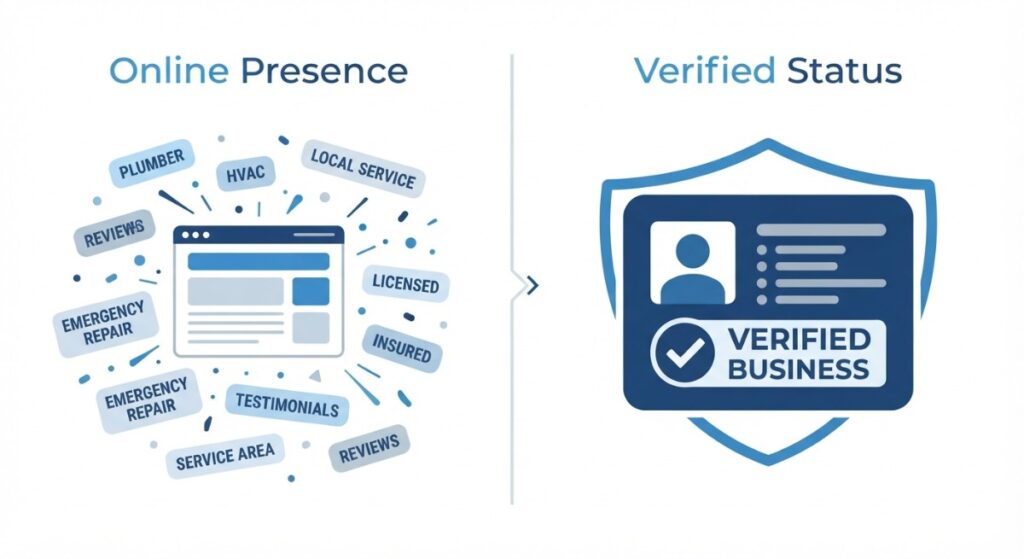
Where should your license number appear on your website?
This is the practical part, and where we spend most of our time with Connecticut clients.
Why does a visible license number build trust?
DCP tells homeowners to verify a contractor's registration before hiring. Careful homeowners do exactly that. When your number is right there on the page, you remove a step. When it is missing, you add one, and some people simply move on to the next result.
Think about those DCP numbers again: about 1,000 complaints a year, and 265 about unregistered contractors. Homeowners hear about those stories from neighbors. Your site has a few seconds to show you are not one of them.
What are the best places to show it on your site?
Here is the placement checklist we use on our builds.
| Placement | What to show | Why it matters |
|---|---|---|
| Sitewide footer | Credential type, number, "Registered with CT DCP" | Visible on every page, including every ad landing page |
| Header or trust strip near the phone button | A short line with the registration number plus "Insured" | Answers the trust question above the fold |
| Contact page | Full legal name, address, number and a link to the eLicense lookup | Where cautious homeowners go before calling |
| Each service page | A credential block with insurance and a review snippet | Ads and search traffic often land here first |
| Quote form and thank you page | The number, plus a note that the estimate will include it | Reassures people at the moment they commit |
| Estimate PDFs and contracts | Name, address and number | Required in the contract itself under section 20-429 |
| About page | Owner name, years in business, credentials, type of insurance | Puts real people behind the business |
When we build a site, the credential line goes in the footer, on the contact page, inside the trust block on each service page, and in the schema markup. That is our standard practice, not an add on. For examples of full sites that convert, see our pressure washing website examples that convert.
How should you word it so it is not just "licensed and insured"?
"Licensed and insured" is a claim. A number is proof. Here are three model lines we use as a starting point:
- Home improvement contractor: "Registered Home Improvement Contractor, CT DCP Registration HIC.0000000. Verify at elicense.ct.gov."
- Licensed trade: "Connecticut licensed plumbing contractor. Our license number appears on every estimate and can be verified on eLicense."
- Insurance: "Fully insured with general liability coverage. Certificate of insurance available on request."
The number in the first line is a format example only. Copy your own number exactly as it appears on your DCP certificate.
A few honest rules. If your credential is a registration, call it a registration, not a license. Never list your insurance policy number publicly; offer the certificate instead. And only use "bonded" if you actually carry a bond, because Connecticut's HIC rules ask for insurance, not a bond.
What about insurance, BBB, reviews and other proof?
Your registration number is the anchor. These support it:
- Insurance: DCP's minimum is $20,000 in general liability, and many contractors carry more. State what you can prove.
- BBB accreditation: if you hold it, link to your profile.
- Reviews: embed your Google reviews and reply to them. You can see how we handle feedback on our own what our clients say page.
- Awards: real, checkable ones only. Mr-Suds, for example, earned a BusinessRate "Ranked #1" award. A third party award like that supports the trust line, as long as it is real.
Does schema markup with hasCredential help?
Schema markup is code in the background of your page that tells search engines facts about your business. Schema.org includes a hasCredential property that lets a business describe a credential it holds, and who issued it.
Here is a simple model, with example values:
{
"@context": "https://schema.org",
"@type": "HomeAndConstructionBusiness",
"name": "Example Home Services LLC",
"address": {
"@type": "PostalAddress",
"addressLocality": "Hartford",
"addressRegion": "CT",
"addressCountry": "US"
},
"hasCredential": {
"@type": "EducationalOccupationalCredential",
"credentialCategory": "Home Improvement Contractor Registration",
"recognizedBy": {
"@type": "GovernmentOrganization",
"name": "Connecticut Department of Consumer Protection"
}
}
}
Let us be honest about what this does. It helps search engines and AI answers understand your business. It is not a ranking switch, and it will not move you up a page by itself. For the bigger picture, see our posts on entity SEO for contractors and AI Overviews in Connecticut home service search.
How should your license show up on Google Business Profile, ads and LSA?
Your website is one place homeowners check you. Your Google profile, your ads and your trucks are others. The goal is that all of them tell the same story.
Where does it go on Google Business Profile?
A few simple spots:
- Business description: one short line with your credential type and number.
- Photos: pictures of your truck lettering and yard signs that show the number.
- Name and address: the same legal name and address as your DCP record.
Consistency is the point. If your Google Business Profile, website and eLicense record all match, homeowners see one business, and so does Google. Our local SEO in Hartford work and our guide to ranking in the Google Map Pack cover the rest of the profile.
How do you include it in Google Ads, Meta ads and print?
Text ads have little room, so the number often fits better elsewhere:
- On image creatives for Meta and display ads
- Above the fold on the landing page every ad points to
- On vehicles, yard signs and door hangers
- On business cards
Several of those come straight from DCP's own examples. How the rule applies to each digital format is worth confirming with DCP for your business.
What does Google check for Local Services Ads?
Local Services Ads (LSA) are the pay per lead ads at the top of many home service searches. Google's screening and verification page lists, for most home service categories, background checks on the business and owner, state level business and owner licenses "where applicable by local law," liability insurance, and a public, verified Google Business Profile. Requirements vary by category.
Google's LSA policies are just as direct. You may only accept jobs you are licensed, insured and able to complete. And you cannot use the license of a person who does not work for your business.
Google has also moved to a single Google Verified badge and is ending its Money Back Guarantee. Reimbursement requests only apply to services booked through LSA before December 7, 2025.
This article covers only the credential piece. For the full eligibility walkthrough, see our post on Google LSA eligibility for pressure washing.
What happens to your site when the registration renews on March 31?
Every HIC and new home construction registration in Connecticut expires on March 31. A little routine each March keeps your site from showing stale information:
- Set a calendar reminder for early March.
- Renew, then check your status on eLicense.
- Update the footer, estimate PDFs and contracts if anything changed.
- Refresh your certificate of insurance.
- Confirm your LSA documents are still current.
For our clients, the CRM can send that reminder automatically.
What this looks like in practice: a Hartford County example
Back to the Mr-Suds review. Here is the trust review we walk through on a pressure washing site like this one.
The homepage today says "Licensed, Bonded and Insured!" and "Fully insured for your peace of mind." It shows a Google review widget and a service area that runs from Hartford and Newington out to Wethersfield, Rocky Hill, Glastonbury, Farmington, Simsbury and more. That is a strong start. The questions we work through next are the same ones we ask every Connecticut contractor:
- Which credential applies? Based on the services offered, is this cleaning only, or do some jobs, like sealing or staining, cross into home improvement?
- Can a homeowner verify it? If a registration applies, does the number appear in the footer and on the contact page?
- Is the wording accurate? Does every word in the trust line, including "bonded," match what the business actually holds?
- Does it match everywhere? Is the same line on the Google Business Profile, on LSA if used, on the trucks and on every estimate?
We are not sharing a verdict on Mr-Suds here, and we are not claiming a result from these changes. The point is the questions. They apply to almost every home service website in Connecticut.
Now a quick contrast. Picture a plumbing company in Manchester, a business like CT Premier Plumbing. It would not lead with an HIC number at all. Its trust line would show a state plumbing license, because that is the credential that covers its work. Same checklist, different credential.
Our founder, Shohanur Reza, built our process around one simple practice: the credential goes into every site we launch, in the same places, every time. Not as a design flourish, but because it answers the first question careful homeowners ask.
Quick checklist: is your Connecticut contractor website trust ready?
- Correct credential type named (registration or license)
- Number in the footer, on the contact page and on service pages
- Same legal name and address as your eLicense record
- Insurance stated honestly, with a certificate available on request
- Number on estimates and contracts, with the cancellation notice
- Reviews embedded and answered
- Google Business Profile, ads, vehicles and LSA all match
- hasCredential schema added
- March 31 renewal reminder set
Frequently asked questions
Do you need a license to be a contractor in Connecticut?
Most residential home improvement work over $200 requires a Home Improvement Contractor registration with the Department of Consumer Protection. Trades like plumbing, electrical and heating and cooling need occupational licenses. Connecticut has no general statewide "contractor license" for home improvement; the registration is the credential most contractors need.
How much does Connecticut HIC registration cost?
DCP lists a $220 non refundable application fee, made up of a $120 registration fee and a $100 yearly Guaranty Fund fee. You also need at least $20,000 in general liability insurance. Every registration expires on March 31 and must be renewed each year to stay active.
Does my registration number have to be on my website?
Connecticut law requires registered home improvement contractors to include their registration number in any advertisement. We treat a website as advertising and recommend showing the number in the footer and on the contact page. This is our reading, not legal advice, so confirm your situation with DCP.
How can a homeowner verify a contractor in Connecticut?
Use the Connecticut eLicense lookup at elicense.ct.gov. Choose the license type, search by business name or number, and open the record. Check that the status is active and that the name matches the name on the contract or estimate before paying any deposit.
Do pressure washing companies need HIC registration in CT?
DCP lists cleaning services as excluded property maintenance, and pressure washing is not named on its list. But jobs bundled with sealing, staining, painting or repairs can look like home improvement. Email DCP.HomeImprovement@ct.gov with a description of your services for a definite answer.
Do painters need to be registered in Connecticut?
Yes, in most residential cases. Painting is on DCP's list of home improvement work, so residential painting contracts over $200 generally require a Home Improvement Contractor registration. Commercial painting and subcontracted work fall outside the Home Improvement Act.
What is the Home Improvement Guaranty Fund?
It is a state fund that can pay eligible homeowners up to $25,000 per claim when they hold an unpaid court judgment against a contractor who was registered with DCP. The project must be over $200 on a home with six units or fewer, and the claim must be filed within two years.
What happens if a contractor advertises without a registration number?
The Home Improvement Act allows DCP to impose a civil penalty of up to $1,500 per violation. Beyond the penalty, an ad without a number gives careful homeowners one more reason to call the competitor whose number they can check.
Does Google verify contractor licenses for Local Services Ads?
Yes, where they apply. Google's screening for most home service categories includes business and owner checks, state level business and owner licenses where local law requires them, liability insurance and a verified Google Business Profile. Exact requirements vary by category.
Does adding a license number help SEO?
Not directly as a ranking factor. What it does is build trust with homeowners, keep your business details consistent across your site, Google profile and directories, and help conversions. Schema markup with hasCredential helps search engines understand the business, but it is not a ranking shortcut.
Conclusion and next step
Connecticut contractor licensing comes down to three steps for your marketing. Know which credential you actually hold. Show it everywhere you advertise. Keep it the same across your website, Google profile, ads, trucks and estimates.
None of this is complicated. Most of the fixes in this article take an afternoon. They also do something quietly powerful: they answer the homeowner's first question before they have to ask it. Across New England, careful homeowners check before they hire. Make it easy.
One more reminder: MR Web Solutions is a marketing agency, not a law firm. This article is general information, not legal advice. Confirm your own situation with the Connecticut Department of Consumer Protection.
If you would rather have us check it, book a free growth audit. It includes a credential and trust signal review of your site and Google Business Profile. If you are planning a rebuild, our Hartford website design work builds all of this in from day one. And with an AI receptionist with a 14 day free trial, the answer to "are you licensed and insured?" is the same at 9pm as it is at 9am.