It is a spring weekday in Newington. The house is half washed. One guy is up a ladder, the other is holding the wand, and the phone in the truck is buzzing on the dashboard. Nobody can stop to answer it.
We see the other side of that moment. We built the Mr-Suds website, we manage its Google Business Profile, and we run its CRM, so we see the calls and leads that come in while the crew is working. That is why we started comparing the AI receptionist vs answering service question seriously. Not as a software review, but because we kept asking what it really costs to make sure that call gets answered.
This article puts real 2026 prices from human answering services and AI receptionists side by side at 100, 300 and 600 calls a month. It adds what an in house receptionist costs in Connecticut, and what a missed call can cost a home service business in the Hartford area.
One thing up front: MR Web Solutions sells an AI receptionist. We will still tell you where a human service is the better buy, because sometimes it is.
AI receptionist vs answering service: which costs less?
At 100 calls a month, a human answering service typically costs about $400 to $950, while an AI receptionist costs about $50 to $150. At 600 calls, human services run roughly $2,300 to $4,950 and AI about $300 to $525. Humans still win on emotional or complex calls, so many home service businesses use a hybrid.
Those figures assume an average call of 2.5 minutes, which comes from PATLive's own plan notes. The full table, with every vendor and every source, is further down.
What is the difference between an AI receptionist and an answering service?
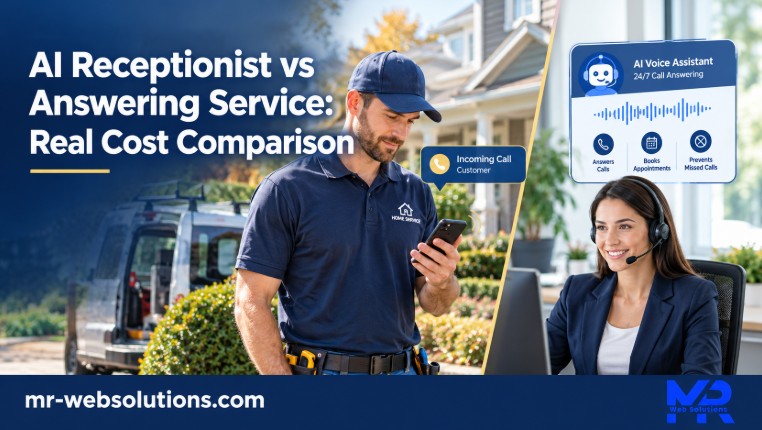
An answering service is a team of live agents in a call center. They answer your line with your script, take messages, and sometimes book appointments. Many of them call themselves a virtual receptionist. Ruby, PATLive, AnswerConnect, Abby Connect and Smith.ai all work this way, and most bill per minute or per call.
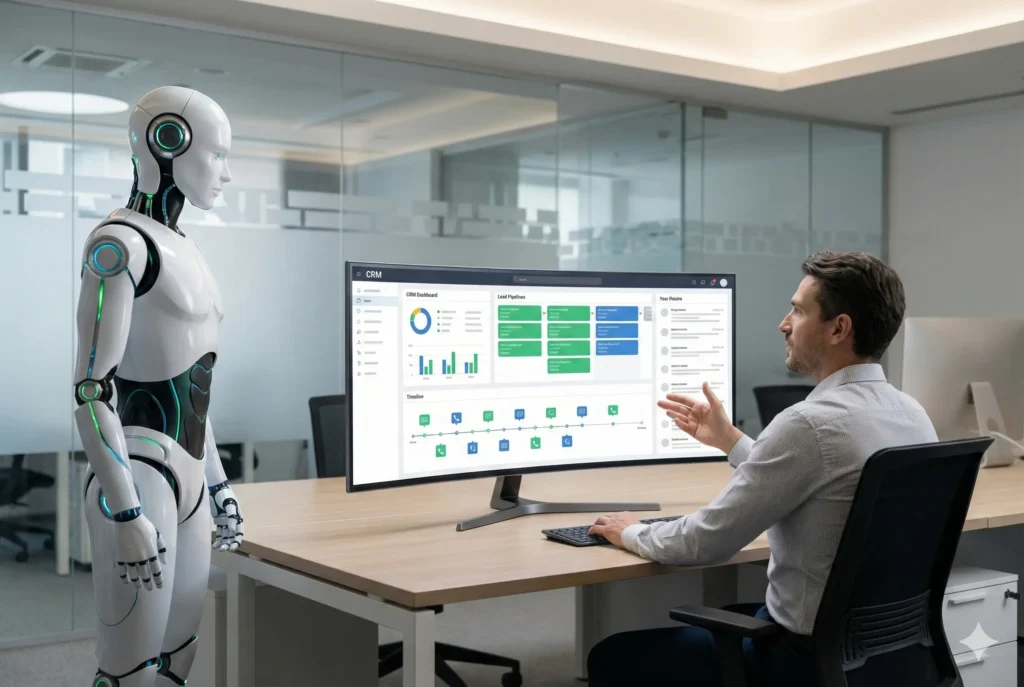
An AI receptionist is a software voice agent. It picks up instantly, can handle several calls at the same time, books into your calendar and logs each caller into your CRM. Dialzara, Goodcall, Rosie, Smith.ai's AI tier and GoHighLevel's Voice AI are examples. Billing is usually a flat plan, a minute bundle or a count of unique callers.
The practical difference for a crew in the field comes down to three things:
- Speed: AI answers on the first ring, every time. Human services can have hold times when they are busy.
- Capacity: AI takes simultaneous calls. A human agent takes one at a time.
- Judgment: A human can calm an upset customer and think through an odd request. AI follows the rules you give it.
Where does an in house receptionist fit?
It is the third option. A person at a desk in your office, on your payroll, covering office hours. It is the most expensive of the three for most small crews, and it leaves nights and weekends uncovered. We run the Connecticut numbers for it below.
How do answering services and AI receptionists charge?
This is where most owners get surprised. Four billing models are common, and the same month of calls can cost very different amounts under each one.
Per minute plans (Ruby, PATLive, AnswerConnect, Abby)
You buy a bundle of minutes. Go over, and every extra minute costs more.
PATLive's pricing page lists a 200 minute plan at $349 a month, with extra minutes at $1.99. Ruby is pricier. According to CloudTalk's Ruby pricing summary, updated August 31, 2026, Ruby's 200 minute plan is $720, with overage at $4.40 a minute.
Per call plans (Smith.ai human receptionists)
You pay for a set number of calls, no matter how long each one lasts.
Smith.ai's human Starter plan is $292.50 for 30 calls, with extra calls at $10.50 each. The Pro plan is $975 for 120 calls, with $7.50 overage. Those figures come from a fast.io review of Smith.ai updated June 27, 2026.
Unique caller plans (Goodcall)
Goodcall counts callers, not calls or minutes. If the same customer calls three times from the same number, you pay once.
Per CloudTalk's Goodcall pricing guide, updated May 2026, Starter is $79 for 100 unique callers, Growth is $129 for 250, and Scale is $249 for 500. Each extra unique caller is $0.50.
Flat or bundled minute plans (Dialzara, Rosie, GoHighLevel Voice AI, MR Web Solutions)
Dialzara's pricing page lists Business Pro at $99 for 220 minutes, with overage at $0.45 a minute.
Rosie's Professional plan is $49 for 250 minutes. Instead of charging overage, Rosie automatically moves you to a higher plan when you go past your allowance, according to CloudTalk's Rosie guide.
GoHighLevel's Voice AI starts around $0.06 a minute plus phone and model costs, or $97 a month per subaccount for its AI Employee Unlimited plan, per BotPenguin's GoHighLevel pricing breakdown verified September 4, 2026.
Our AI receptionist plans are flat: $79, $149 and $349 a month, split by features and the number of AI call assistants, not by minutes.
What does each option really cost at 100, 300 and 600 calls a month?
When we price this for a client like Mr-Suds, the first thing we look at is call volume by month. Spring and summer look nothing like January in a Connecticut washing business. So we priced three volumes: a quiet month, a busy month and a peak month.
Here are the assumptions, in one place:
- 2.5 minutes per call. PATLive's own plan notes say 50 minutes is about 20 calls.
- Cheapest published plan plus overage for each vendor at each volume.
- Taxes, add ons and setup fees excluded unless noted.
- Every call counted as a unique caller for Goodcall, the worst case for that model.
| Option | 100 calls (about 250 min) | 300 calls (about 750 min) | 600 calls (about 1,500 min) | Source and date |
|---|---|---|---|---|
| PATLive (human) | $448.50 | $1,206.50 | $2,344 | PATLive pricing, Oct 2026 |
| AnswerConnect (human) | $395 | $1,222.50 | $2,610 | Vida AnswerConnect guide, Apr 2026, third party |
| Abby Connect (human) | $748.50 plus $95 setup | $2,070 | $4,140 | FitSmallBusiness review, Nov 2024, older figures |
| Smith.ai (human) | $912.50 | $2,325 | $4,575 | fast.io review, Jun 2026 |
| Ruby (human) | $940 | $2,550 | $4,945 | CloudTalk Ruby summary, Aug 2026 |
| Rosie (AI) | $49 to $149 | $149 | $299 | CloudTalk Rosie guide, Aug 2026 |
| Goodcall (AI) | $79 | $154 | $299 | CloudTalk Goodcall guide, May 2026 |
| Dialzara (AI) | $112.50 | $299 | $524 | Dialzara pricing, Oct 2026 |
| MR Web Solutions AI Receptionist | $79 to $349 by plan | $79 to $349 by plan | $79 to $349 by plan | Our AI receptionist page, Oct 2026 |
| In house receptionist, Connecticut | about $4,837 fully loaded | about $4,837 | about $4,837, plus the after hours gap | BLS OEWS May 2025, BLS ECEC Jun 2026 |
A few lines of the math, so you can check us:
- PATLive at 100 calls: 200 minute plan at $349, plus 50 extra minutes at $1.99.
- Ruby at 300 calls: the 750 minute plan at $2,550.
- Smith.ai at 600 calls: Pro at $975, plus 480 extra calls at $7.50.
- Dialzara at 600 calls: Elite at $349, plus 500 extra minutes at $0.35.
- Rosie at 100 calls: Rosie rounds each call up to the next full minute, so 100 calls of 2.5 minutes can bill as 300 minutes and push you into the $149 plan.
Two labels to keep in mind. Abby's numbers come from a 2024 review, so they may have changed. AnswerConnect's come from a competitor's guide, and its Standard plan used at 300 and 600 calls also carries a $49.99 setup fee.
We offer an AI receptionist with a 14 day free trial from $79 a month, and we will tell you if a human service fits your calls better.
What does that work out to per call?
At 300 calls a month, the gap is easy to see. PATLive works out to about $4.02 per call. Smith.ai is about $7.75, and Ruby about $8.50. On the AI side, Dialzara is about $1.00 per call and Rosie about $0.50. That is the difference between paying a few dollars every time the phone rings and paying pocket change.
What hidden fees change the math?
The plan price is rarely the whole bill. Watch for these:
- Setup fees: Abby charges $95 for scheduling setup, per its add ons page.
- After hours coverage: Abby's 24/7 live coverage is a $95 a month add on.
- Port out fees: AnswerConnect reportedly charges $250 to $300 to move your number away.
- Taxes: PATLive plans are listed "plus government taxes and fees."
- Automatic upgrades: Rosie moves you up a plan when you go over, instead of charging overage.
- Separate phone costs: GoHighLevel bills phone minutes separately from its AI.
And the questions we ask any vendor before a client signs:
- Do you bill in full minutes, 30 seconds or 6 seconds?
- Are spam calls and wrong numbers billed?
- Are there holiday or after hours surcharges?
- Is bilingual answering extra?
- How long is the contract?
What does an in house receptionist cost in Hartford and Connecticut?
For many owners, the instinct is "I'll just hire someone." Here is what that looks like with real Connecticut numbers.
The median wage for receptionists and information clerks in Connecticut is $19.53 an hour, or $40,630 a year, based on BLS OEWS May 2025 data. The national median is lower, at $38,010.
Wages are only part of the cost. In June 2026, benefits made up 30.0 percent of private industry compensation costs, according to the Bureau of Labor Statistics. Add that on, and a median Connecticut receptionist costs about $58,000 a year fully loaded. That is about $4,837 a month.
Now look at the hours. A full time receptionist covers about 40 of the 168 hours in a week. Evenings, weekends and lunch breaks are still uncovered. And one person cannot answer two calls at once, which matters on a busy Monday morning after a storm.
For a Hartford County company with an office, walk in customers and a lot of paperwork, that person may be worth every dollar. For a two truck crew that mostly needs the phone answered while everyone is on a job, it is the most expensive way to solve the problem.
Does a part time receptionist make sense for a small crew?
Sometimes. Half time at the Connecticut median works out to roughly $1,690 a month in wages, before payroll taxes and benefits. Connecticut's minimum wage is $16.94 an hour from January 1, 2026, per CBIA, which sets the floor for any part time hire.
The catch is coverage. A part time person covers even fewer hours, and those are usually office hours, not the evenings when homeowners finally sit down and make calls. A fair point in their favor: a real person at the desk builds relationships that software cannot.
How much does a missed call cost a home service business?
On our side of the Mr-Suds account, one pattern is easy to see. The busiest wash days are the days the phone gets answered least. That makes sense. The crew is on site from morning to evening, and every call that comes in competes with the job in front of them.
The question is what those unanswered calls are worth. We do not publish client numbers without permission, so the model below uses national benchmarks, not Mr-Suds data.
A simple missed call model for a pressure washing company
- Start with 100 inbound calls in a month.
- Invoca's 2026 Home Services Benchmarks found 52 percent of callers to home services businesses speak with a person. So 48 do not.
- The same report found 38 percent of answered calls are leads. Applied to the 48 missed calls, that is about 18 potential leads.
- It also found 45 percent of leads convert on the call. That is about 8 jobs.
- Angi puts the 2026 national average to pressure wash a house at $312. About 8 jobs is roughly $2,500 in work at risk.
One honest caveat. Some of those callers leave a voicemail. Some call back. So treat this as a ceiling to compare against, not a loss you can put on a spreadsheet.
Even so, compare it with the table above. A $79 to $300 a month answering tool does not need to save many jobs to pay for itself. If you are already paying for leads, our page on pressure washing marketing in Connecticut covers how those calls get generated in the first place.
Do callers really move on when nobody answers?
Many do. Invoca's 2026 buyer survey, as reported by Stealth Agents, found that 51 percent of home services buyers stopped after contacting one provider, and 66 percent hung up when a call went unanswered. The same summary cites a CallRail January 2025 benchmark showing home services businesses missed 14 percent of calls.
Both figures come through a secondary source, so read them as a direction, not gospel. The direction is clear, though. The first company to pick up often gets the job.
Do Google Local Services Ads now charge for missed calls?
For some calls, yes. From October 1, 2026, unanswered calls to Local Services Ads advertisers during business hours can count as billable leads if the caller stays on the line past 20 seconds, according to PPC Land.
That changes the math. You can now pay for a lead you never spoke to. If you run LSA, check your account settings and Google's help pages, and read our post on Google Local Services Ads for pressure washing.
Where does a human answering service still win?
This is the part most vendor articles skip. We tell clients these things directly.
Emotional and upset callers
A homeowner calls because they think the crew damaged a plant bed or etched their deck. They are upset, and they want a person. Not a script, and not a menu.
These calls should go to a trained human agent or straight to the owner. Handled well, an upset customer often becomes a loyal one. Handled by a bot that keeps asking for their ZIP code, it becomes a one star review.
Complex quotes and commercial bids
HOA boards, property managers and commercial accounts ask layered questions. Can you work around tenant parking? Do you reclaim wash water? Can you schedule across six buildings over two weekends?
AI should not quote these. It should capture the details, book an estimate and pass it to a person. We cover how those deals work in our post on commercial and HOA bids.
Callers who refuse to talk to a bot
Some people will hang up the moment they hear an AI voice. That is real, and we will not pretend otherwise.
Two things help. A short, honest greeting that says it is an assistant, and an easy way to reach a person, like saying "operator." Callers mind a bot far less when they know a human is one word away.
Our rule of thumb
If most of your calls sound like "Do you serve my town? How much? When can you come?", AI handles them well. If most of your calls need judgment, negotiation or calming someone down, budget for humans.
Can you use an AI receptionist and an answering service together?
Yes, and for many home service businesses it is the best answer. AI handles the volume. Humans handle the exceptions.
What does a hybrid setup look like for a Hartford area contractor?
Picture a pressure washing company in Newington or Wethersfield. Here is how we would wire it:
- AI answers every call, 24/7. It collects the caller's name, address and the service they need.
- Photos by text. The caller gets a text asking for a photo of the house or deck, so the owner can price it faster.
- Booking. The AI books an estimate straight onto the calendar.
- CRM. The lead lands in the GoHighLevel pipeline with an instant SMS confirmation to the customer.
- Transfers. Calls flagged as urgent or upset ring the owner's cell, or roll to a human overflow line.
This is the same kind of pipeline and SMS follow up we set up in the CRM for our clients. If you are still picking a system, our guide to choosing a CRM for your crew compares the main options.
The hybrid shines during surges. A nor'easter sends roofers and gutter companies a flood of calls in a single morning. A human service queues them. AI takes them all at once, and passes the urgent ones to a person.
What does a hybrid cost per month?
Less than most owners expect. Take an AI plan for the bulk of your calls and add a small pay as you go human plan for transfers.
PATLive's pay as you go plan is $49 a month plus $2.99 a minute. Twenty transferred calls at 2.5 minutes each is 50 minutes, or about $150. Add the base fee and the human side comes to about $199 a month, plus your AI plan.
So a busy crew can get 24/7 AI answering and real humans for the hard calls for roughly $280 to $550 a month, depending on the AI plan. That is still far below a single human service at 300 calls.
Is it legal to record AI receptionist calls in Connecticut?
It can be, if you do it right. Most AI receptionists record and transcribe calls, so this matters.
Connecticut has two layers. Under criminal law, only one party needs to consent. But under civil law, Conn. Gen. Stat. 52-570d, recording a phone call without the consent of all parties can expose a business to damages. The RCFP Connecticut recording guide lists three ways to get that consent:
- Written consent from all parties
- Verbal consent from all parties, recorded on the call
- A recorded warning that the call is being recorded
For an AI receptionist, the third option is the simple fix. Add a short line to the greeting, such as "This call may be recorded." Pair it with an honest note that the caller is speaking with an assistant.
Outbound calls are a separate issue. In February 2024, the FCC ruled that AI generated voices count as "artificial" voices under the TCPA, so the usual prior consent rules apply. Baker McKenzie's summary covers the details. If your AI will call people back on its own, get clear consent first.
This is general information, not legal advice. For anything unusual, talk to an attorney.
Which should a Connecticut home service business choose?
Here is the checklist we walk through with owners:
- Under about 50 calls a month, mostly simple questions: a low cost AI plan or a small per minute human plan both work.
- 100 to 600 calls, mostly booking and pricing questions: AI or a hybrid is far cheaper, per the table above.
- A high share of emotional, legal or complex calls: a human service or a hybrid.
- Strong seasonality (spring wash season, fall leaf and gutter season, winter storm calls): favor plans without steep overage, because one busy month can wreck a minute bundle.
- Already paying for Google Ads or LSA: every unanswered call is paid traffic lost. Our posts on what each Google Ads lead costs and how much to spend on marketing show why that adds up.
If the second line sounds like you, our AI receptionist with a 14 day free trial starts at $79 a month. If the third line sounds like you, we will say so and point you toward a human service.
Practical example: what we would set up for a Hartford pressure washing crew
Here is how we would plan it for a crew like the Mr-Suds team, working Newington, Hartford and the towns around them.
The greeting. Short and honest: "Thanks for calling. I'm the assistant for the team, and this call may be recorded. How can I help?" It discloses the AI, covers the Connecticut recording rule and gets to the point.
The questions. What town are you in? What needs cleaning: the house, a deck, a fence, the gutters? Is there a good day for an estimate? Can we text you for a photo?
The transfers. Anyone upset about a past job, anyone asking about a commercial property, and anyone who asks for a person goes straight to the owner's phone.
The end of the day. The owner opens the CRM and sees every call: who called, what they need, which estimates are booked and which leads need a callback. Nothing lives only in a voicemail box anymore.
Our view, after setting up CRMs and call flows for home service clients, is simple. The cheapest answer is not always the right one. The right one is the setup where every caller gets a real response, and the owner stops wondering which job went to the competitor. You can read what our clients say about working with us.
Frequently asked questions
Is an AI receptionist cheaper than an answering service?
At almost every volume we priced, yes. At 300 calls a month, the third party AI tools we priced ran about $149 to $299, while human services ran about $1,206 to $2,550. The gap narrows at very low volume, or when a large share of calls must transfer to a person anyway, which is where a hybrid makes sense.
How much does an answering service cost per month?
Entry plans start around $99 for 50 minutes with PATLive and about $350 for 200 minutes with AnswerConnect. At 100 calls a month, expect roughly $400 to $950. Overage ranges from $1.49 a minute on PATLive's largest plans to $5.40 on Ruby's entry plan, so check the overage before you sign.
How much does an AI receptionist cost per month?
Published plans run from about $29 to $349 a month across Dialzara, Rosie, Goodcall and our own plans. The bigger question is what happens when you exceed the plan: per minute overage, per caller charges or an automatic upgrade. Read that part of the pricing page closely.
Do callers know they are talking to an AI?
They should. We recommend saying so in the greeting. It builds trust, it avoids the feeling of being tricked, and it fits naturally with the recording notice Connecticut's civil rule calls for. An easy way to reach a person keeps the callers who would rather talk to a human.
Can an AI receptionist book jobs into my calendar?
Yes, when it is connected to your calendar and CRM. The AI checks open slots, books the estimate and sends the customer an SMS confirmation. The lead then sits in your pipeline with the caller's details, so nothing depends on someone remembering to write it down.
What happens when the AI cannot answer a question?
A good setup has rules for that. The AI can transfer the call to a person, take a detailed message, or notify your team right away. Set clear triggers for urgent calls, upset callers and commercial inquiries so those always reach a human quickly.
How much does a receptionist cost in Connecticut?
The Connecticut median is $19.53 an hour, or $40,630 a year, per BLS May 2025 data. With benefits at 30 percent of total compensation, a full time receptionist costs about $58,000 a year fully loaded, or roughly $4,837 a month, and still covers only office hours.
Is it legal to record calls in Connecticut?
Connecticut's civil law, Conn. Gen. Stat. 52-570d, calls for the consent of all parties before recording a phone call. Consent can be written, verbal and recorded, or given through a recorded warning on the call. A short "this call may be recorded" line in the greeting is the standard fix.
Can I use AI and a human answering service together?
Yes. A hybrid lets AI answer every call 24/7, capture details and book estimates, while urgent, upset or complex callers transfer to the owner or a human service. With a small pay as you go human plan, the human side can cost around $200 a month on top of the AI plan.
How much does a missed call cost a home service business?
It depends on your lead rate and average ticket. Using Invoca's 2026 benchmarks and Angi's $312 average pressure washing job, roughly one in six missed calls is a likely job. At 100 calls a month, that can put about $2,500 of work at risk.
The honest bottom line
AI wins on cost and coverage. It answers every call, day or night, for a fraction of what a human service charges at the same volume. Humans win on empathy and judgment, especially with upset customers and complex commercial bids. For many home service businesses in Hartford County, the best answer is a hybrid: AI for the routine calls, people for the hard ones.
Whatever you choose, run the numbers at your own call volume, not an average. Look at your busiest month, not your quietest.
If your calls are mostly booking and pricing questions, try our AI receptionist free for 14 days and listen to the recordings yourself. If they are not, we will tell you. You can also book a call with our Hartford team or reach us at +1 (860) 255 1070.